How to Plan on a Budget

By: Sai Igiede, Zuckerberg College of Health Sciences Well-being

It’s Sai, your local well-being leader, and today, we are going to be talking about finances.

As a college student, being stressed isn’t fun. And when you add low funds, it can feel very daunting! Whether you want to spend less money because of a cool trip you’re saving for, or you want to decrease your spending habits. This post is for you!

First, you have to ask yourself a few questions:

  • Why am I saving?
  • Is there a specific amount in mind that I want to save?
  • Do I want to set a limit on how much I spend?

These are some of the questions you might want to think about when it comes to your own personal finances. Let’s use me as an example. I want to start saving my money because I don’t make a generous amount of income. Something I could do, and I highly recommend this for anyone, regardless of their circumstance, is

  1. The Financial Seed

The financial seed at UML is also a great resource that helps with not only financial literacy but also things like budgeting. It is free for students, staff, and faculty members as well. I highly recommend this as well!

https://www.uml.edu/myuml/submissions/2025/2025-09-08-10-17-20-start-growing-your-financial-future.aspx

2. Creating/Using a budget sheet

When it comes to finances, a lot of people try to do all the mental math in their head, which can work for some, but I know for me, it doesn’t. I try and try again, yet fail every time. So I started to use a budgeting Excel sheet that looks at my income, how much money I would like to spend, how much I want to save, and pocket change for emergencies (like a random boba run with friends at 3am). There are a lot of free budgeting templates online if you are also not comfortable making one yourself.

But Sai, what if I still want to have fun while saving money? When it comes to saving money, a lot of people equate spending less money with not having fun/events. Whenever my boyfriend and I want to hang out, we are always thinking about some cool, cost-effective activities within Lowell. Some examples are:

  • Picnics
  • Painting
  • Thrifting
  • Going to the Movies
  • And many more…

Managing your finances can be stressful for a lot of reasons. However, making sure you have a plan in place can definitely make you feel not only less stressed but also more organized.

Until next time,

Sai 

Facing the Cold

By: Devansh Ramani, Francis College of Engineering Well-Being Leader

The cold may affect us from the outside, but the burning passion of the mind should never allow the body to stop progressing. As students, this idea reflects the challenges we face every day in both academics and personal growth. Difficult subjects, long study hours, stress, and self-doubt can feel overwhelming, yet determination and focus push us forward even when motivation feels low.

Facing the Cold

The “cold” represents the obstacles that slow us down — distractions, fear of failure, burnout, and moments of self-doubt. These challenges can make learning feel exhausting and progress feel uncertain. It’s easy to believe that success should come naturally, but true achievement rarely comes from comfort.

Instead, success is built through perseverance, discipline, and the willingness to keep going when the journey feels difficult. Growth often happens in the moments when quitting feels easiest.

Progress Through Effort

As we work toward our goals, fatigue and frustration are unavoidable. Late-night studying, exam preparation, and balancing multiple responsibilities can strain both the mind and body. On those days, progress may feel small or slow.

Yet every effort matters. Each assignment completed, each concept understood, and each challenge faced contributes to our growth. Over time, these efforts strengthen our confidence and build resilience.

The Fire Within

The burning passion of the mind is our curiosity and desire to improve. It reminds us why education matters and keeps us connected to our goals. Passion doesn’t mean constant motivation — it means commitment, even when things feel difficult.

When passion drives effort, challenges become stepping stones rather than barriers, shaping us into stronger and more capable individuals.

Moving Forward

There is always work to be done, and every small effort counts. If we remain focused and determined, we can overcome obstacles and continue moving forward. The cold may slow us temporarily, but the fire of ambition and hard work will always guide us toward success.

Finding the Light in the Darker Months: A Guide to Self Care and Wellness 

By: Nokomis Bramantecohen, College of Fine Arts, Humanities, and Social Sciences Well-Being Leader

Introduction:

During our time living in New England the temperature drops and our world becomes quieter and darker. Because of this, it becomes easier to slip into habits that may make you feel drained, unmotivated and/or isolated… it might make the simplest of tasks feel the most heaviest. This is why the winter season is one of the most important seasons to practice and focus on intentional self care. 

Taking care of yourself in the winter isn’t just about staying warm, although it is a big part of it, it is also about supporting your body, mind, and spirit! Making sure to keep your immune system strong and healthy, managing the seasonal depression, and finding the little bits of joy through the cold and dull days. Below I have put together a list of helpful tips and tricks to navigate the season with more comfort, warmth, and groundfulness. 

Tend to Your Physical Well-Being: 

  • Bundle Up: Seriously! New England winters don’t play around! I always remember my parents and teachers telling me to wear a bunch of layers when I was a kid and I didn’t want to listen to them. But now I find myself telling my friends, peers, and kids to bundle up and wear thermals, a heavy coat, hats, gloves, scarves, and layers in general! It’s best to keep the head and feet especially warm because that is where the most heat is lost! 
  • Warm Meals and Drinks: Drinking hot beverages like tea, hot chocolate, lemon water, and other warm fluids helps regulate the body’s temperature and soothe the through. You can also consume cozy foods too like soups, stews, oatmeal, and other foods like that to help maintain energy for the body to stay warm 
  • Warm Baths and Moisturizer: Partaking in a warm bath or shower can soothe tight muscles and help your body relax through all of the cold days! Make sure to follow up with moisturizing and hydrating your skin with some moisturizer after the well deserved long shower!

Protect Yourself During Cold and Flu Season  

  • Stay Bundled to Avoid Getting Run Down: Like I said before, make sure to stay bundled! Your body uses so much more energy to stay warm, and staying warm helps the immune system stay strong rather than receive constant chills. 
  • Wash Your Hands Often: During the winter time there are more people inside. More people inside equals more germs shared on daily surfaces. Make sure to wash your hands frequently or even carry a little bottle of hand sanitizer with you! 
  • Boost Immunity: Make sure to sleep well and get at least seven to eight hours of well rested sleep, along with drinking a lot of water to keep the body hydrated within the cold, and lastly remember to keep up with vitamins. These vitamins can be found in citrus, berries, greens, and soups packed with vegetables. 

Bring in the Light 

  • Turn on the Lights Early: As the shorter days start to arrive it can throw off our energy levels! Make sure to turn on the lights as soon as you wake up either with a warm sunset lamp or the overhead, they both do the trick! Also make sure to turn on the lights during the evening as well. Once it hits 5 pm the sky starts to darken, so make sure to let the light in!
  • Study in Third Spaces: If your room feels dark and/or inspiring, studying as places like the library, cafe, and/or the student lounge can help motivate yourself and others through the winter slump!
  • Let Natural Light in: Even if it’s only for a brief period of time, try to go outside or open the window curtain when there is natural light out. It will help regulate the sleep cycle and one’s emotions!

Plan a Little “Pick-Me-Up”

  • Small Treats Can Go a Long Way: Treating yourself doesn’t have to be a huge deal! But rather a small cup of coffee, a warm cookie, or even your favorite comfort meals. Even going to take yourself out on a movie date, make sure to incorporate some time to focus, care, and to treat yourself.
  • Explore Free Winter Activities: Many cities and local towns have entirely free or low cost holiday events like treelightings, winter markers, outdoor skating, gingerbread displays, light festivals, campus events, etc! These are great ways to reward yourself after a long study session or a “pick me up” to get into the holiday cheer!
  • Create Some Cozy Traditions: Make a winter playlist, bake a warm dessert, create a festive piece to celebrate the holidays! Create a little tradition to look forward to every year, doing so makes the holidays feel more magical!

Move Your Body

  • Indoor Workouts and Yoga: Online workouts, stretching routines, and even quick ten minute mindfulness meditation can help keep your body from feeling stiff! You don’t need any equipment, but just a positive mindset! 
  • Short Walks: Bundle up and take a walk between classes or when the sun is still out. Fresh air (even cold air) can help wake up your senses and help boost your mood)!
  • Winter Activities: If you enjoy being outside, try to take part in the seasonal activities like sledding, ice skating, and even hiking. Moving around and surrounding yourself with nature can help the winter sluggishness. 

Nourish Your Mind and Emotions 

  • Journal and “Brain Dump”: Write anything and everything! What stressors are on your mind and what are some coping mechanisms to help combat the stress? Journaling helps make the noise in your head disappear.
  • Stay Connected: It’s easy to accidentally isolate yourself during the winter time. Remember to reach out to your friends. Grab lunch, plan a study date, or even plan a call!
  • Honors Your Energy Levels: If the winter makes you feel more tired and groggy that is normal! Allow yourself to take rests, slow the pace down, and take breaks when needed. Remember that you do not need to be productive 24/7, especially within the darker months of the winter time. 

Thank you so much for reading my last article written for the Fall 2025 semester! It has been a pleasure to share my thoughts and emotions. To whoever is reading this, I’m glad you’ve read this blog the whole way through and just know you will get through these dark and cold months, always remember to let the light in! 

Life Is Coming From You, Not At You

By: Fatin Rahman, Francis College of Engineering Well-Being Leader

As I wrap up 2025, I keep returning to the mantra that carried me through every ridiculous, painful, chaotic moment this year: life is coming from you, not at you.

I think about all the times things felt out of control, when I sprained my ankle in March and had to walk around campus with a limp, when I injured my hip in November and was forced into bed rest, annoyed and embarrassed that I wasn’t more careful, especially during midterms. I think about my birthday in October, when I completely broke down from the pressure of classes, work, clubs, deadlines… just everything.

And yet, that mantra pulled me through every single time. It reminded me that there is no invisible hand shaping my fate. Things happen, yes: inconvenient, painful, unfair things. But  I decide what I make of them. I’m not the victim of my life’s circumstances; I am the one steering through them.

I think back to that Tuesday in November. I knew the injury was bad, but the consequences hadn’t sunk in yet. My mind spun out instantly: What events will I miss? Will my boss think I’m unreliable? How many classes will I fall behind in? Am I really starting from zero in the gym again after working so hard?

And then, almost like a snap:  So what?  If I have to restart, I’ll restart. I’ve done it before. I survived because I refused not to.

When the world starts closing in, when exams pile up, when work responsibilities stack, when the “halfway-through-college” panic hits,  I remind myself how far I’ve come simply from not yielding. Reframing everything this way has been my greatest strength. I’ve given a few horrible presentations that made me want to hide under a rock. I’ve had days where nothing went right. But progress isn’t linear; it’s messy, humbling, and sometimes just straight up mean.

Still, I don’t fold. Because whatever unstoppable force life decides to fling at me meets something even stronger: my will, my resilience.

And that’s why I cling to the things that keep me grounded: the gym, my friends, spontaneous city trips, small routines that remind me life is still good and still mine. People always ask, “How do you do it all?” and I always start with this quote.

Life is coming from you, from your choices, your strength, your mindset, not at you. And the moment I started believing that, everything changed.

From FOMO to Focus: How to Reset Your Overwhelmed Brain

By: Soham Sawant, Kennedy College of Sciences Well-Being Leader

For many students, college isn’t just academically difficult; it’s a daily battle against an environment that feels fundamentally built for a different type of brain. Big Lecture halls, fluorescent lights, scientific concepts and long and difficult course content. Pair these with crushing deadlines and approaching finals, having even a second to yourself feels like a luxury.

Recently the feeling of overstimulation has been prevalent on campus, everyone seems to be feeling overwhelmed by academics, social interactions and some are even feeling the\ word “fomo”, the fear of missing out. Though these effects are faced by everyone it is particularly more difficult for students who have some form of diagnosed or undiagnosed neurodivergence.

Even though medical care is something you should definitely seek if you require, there are some little habits that you can implement to lessen the feeling of overstimulation and get a hold of your own attention.

Before getting into the actual habits we should first understand why and how this usually happens. On university level and in this era with phones and short-form content, it is really easy for students to get stuck into these dopamine sticking points. Despite the fact that short-form content is a much more convenient way of delivering information, we forget that our brains get used to only having stimulation is short bursts. This might seem not that big of a problem but in the overall life of a student, it can lead to big issues.

Because of the now dulled brain, anything even slightly more longer than the short-form content seems too much. Sitting in a lecture now feels like a chore, focus starts to dwindle withing the first few minutes. Homeworks which aren’t meant to be such that they require you to use your brain to focus for longer periods, seem daunting and near impossible.

So, how do you start to fix this? The first step is just becoming more self-aware. Learn to spot the signs. Are you reading the same sentence over and over? Does the noise in the cafeteria suddenly feel way too loud, making you irritable? That’s your brain signaling that it’s tired. Instead of just pushing through, listen to it. This is the perfect time to use our campus resources. Find that “serenity center” or wellness room you’ve heard about. Remember the massage chairs tucked away on the third floor of UCrossing. Go use one for 15 minutes. Taking that small, deliberate break isn’t being lazy; it’s a strategic way to reset your brain so you can actually be productive later.

Taking a minute for yourself is a great on-the-spot fix, but if this feeling of being overwhelmed is becoming your default, you need to talk to someone. And remember, “professionals” aren’t just doctors. Your teachers, your faculty advisor, and even the sta in your department are trained professionals who want you to succeed. Go to your professor’s office hours. You don’t have to give them your life story, but just saying, “I’m feeling really overwhelmed by the pace of the class and am struggling to focus,” can open a door. They can offer assistance, like breaking down the content, or point you to academic support you didn’t even know existed. They see this all the time, and you’d be surprised how many resources are available if you just ask.

Cozy Fall Blueberry Muffins with Crumble

By: Nokomis Bramantecohen, College of Fine Arts, Humanities, and Social Sciences Well-Being Leader

Introduction 

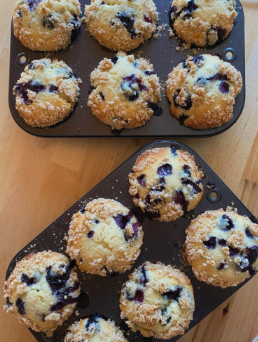
Today I thought I’d share with you all one of my favorite recipes perfect for any season, occasion, or gathering! Although these yummy blueberry muffins are wonderful for any season, my favorite time to bake is the fall and winter! Just one fair warning, once they come out of the oven, they might be gone in minutes because of how warm and flavorful they are! Here is a photo of my finished result, my family devoured them in seconds! I love to bake and decorate cakes, so without further ado, grab an apron, put on some cozy tunes, and let the baking begin! I hope you enjoy these muffins as much as I do, and remember the main ingredient, love!

Ingredients for the batter:

Instructions For the batter: 

  1. Preheat the oven to 400 degrees. 
  2. Prepare a muffin pan with cupcake liners. 
  3. In a large bowl, sift together 2 cups flour, 1 cup sugar, baking powder, and ½ teaspoon salt. 
  4. Set aside.
  5. In a medium bowl, whisk eggs until smooth. 
  6. Add the ½ cup melted butter, milk, and vanilla, and whisk until combined. 
  7. Add egg mixture to flour mixture and stir until combined. (Dough will be lumpy.) 
  8. Fold in blueberries.

For the crumble:

Instructions: 

  1. To prepare the crumble, in a medium bowl combine ¼ cup flour, 2 tablespoons brown sugar, 2 tablespoons granulated sugar, cinnamon, and ⅛ teaspoon salt. 
  2. Using a pastry cutter, cut in butter until the topping is crumbly and coarse.
  3. Fill prepared muffin cups with batter. Top each muffin with streusel topping, about 1 tablespoon each. 
  4. Bake until muffin centers bounce back when lightly pressed, about 18 to 22 minutes.
  5. Cool muffins on a rack for several minutes before removing from the pan.

A Reflection on Winter, Wellness, and Staying Connected

By: Devansh Ramani, Francis College of Engineering Well-Being Leader

It’s that time of year again — winter. And if there’s one thing we know about New England, it’s that the cold doesn’t hold back. The days get shorter, the air sharper, and the temptation to stay bundled up inside our comfort zones feels stronger than ever.

But while the season invites us to slow down, it also reminds us to take care of ourselves — both physically and mentally. The chill in the air may make us want to hibernate, yet our well-being still needs warmth, movement, and connection.

Embracing the Stillness

Winter often carries a quiet that no other season has. Streets are calmer, people walk a little faster, and time seems to stretch. It’s easy to see this as a season of pause — and that’s not always a bad thing.

There’s beauty in stillness. It gives us space to reflect, rest, and appreciate the small comforts that summer’s rush often makes us overlook. But stillness shouldn’t mean stagnation. We can honor the season’s calm while keeping our spirits and bodies active in small, intentional ways.

Moving Through the Cold

Staying active doesn’t have to mean going to the gym every day or running through snow-covered sidewalks. It can be as simple as a morning stretch by the window, a walk around campus or your neighborhood, or even a dance break while you’re making hot cocoa.

The point isn’t perfection — it’s presence. Movement keeps our energy flowing and helps fight the sluggishness that winter can bring. It’s one way of telling ourselves, “I’m still here, still trying, still growing.”

The Warmth of Connection

Just as important as keeping our bodies moving is keeping our hearts connected. Cold weather can make us retreat inward, but reaching out to friends, classmates, or family — even for a quick chat — can do wonders for our mental health. Talking to people who matter reminds us that we’re not alone in facing the winter blues.

Sometimes, warmth doesn’t come from blankets or heaters — it comes from conversations, laughter, and shared moments.

Moving Forward

So this winter, let’s make a simple promise to ourselves: Not to let the cold make us complacent. Not to lose sight of our goals or our relationships. And not to forget that every small effort counts — whether it’s a walk, a call, or just taking a deep breath and stepping outside.

Winter may be cold, but it also carries its own kind of renewal. Let’s embrace it — not by fighting the season, but by finding our balance within it.

“Even in the coldest days, we can still create our own warmth.”

The Courage to Be Seen

By: Fatin Rahman, Francis College of Engineering Well-Being Leader

It’s easy to blend into the background, to be just another face in the crowd, sticking with a group and avoiding attention. It feels safer to stay quiet than to risk saying something imperfect. And when we do speak, we pressure ourselves to be polished to perfection, every word meaningful, every gesture intentional.

As I embark on my co-op next semester, I keep thinking back to the moment that started everything: the fall career fair. I was terrified of saying the wrong thing and stumbling over my words. So I had my friend go first to the recruiter at the company I had my eye on. I followed her “pitch,” echoing her general goals because I didn’t trust myself to stand on my own. I walked away knowing I didn’t stand out. The recruiter was kind, but I wasn’t memorable, and I knew it.

But I also knew I really wanted that job.

By pure luck, that same recruiter visited two of my classes in the days that followed. After each presentation, I walked straight up to her. No overthinking. No rehearsed pitch. Just me showing up, again and again. Polished? Absolutely not. But I was determined.

The interview process ultimately came and went, and then, in the middle of another career fair,  this time at a conference with over 10,000 people, I got the email: I got the offer.

Standing in that crowd with the job secured, something shifted. I walked into the conference career fair with a confidence I’d never felt before. I spoke openly about what I wanted. I didn’t try to sound perfect or impressive. I didn’t memorize lines or mimic anyone else’s goals. I just showed up as myself.

That was more than enough. I made connections for future jobs I’m genuinely excited about, not because I was polished, but because I was present.

What I’ve learned through all of this is simple: the courage to be seen doesn’t come from perfection, it comes from showing up anyway, even when you’re scared. Even when your voice trembles. Even when you think someone else could say it better.

You don’t need to sound like you’re in “Suits.” Real life isn’t about the perfect quip. It’s about being clear about what you want and standing in that truth.

And the best part is, you don’t have to do it alone. I leaned on my friends, their encouragement, their presence. And the more I let people support me, the braver I became. The courage to be seen grows from trusting your voice and allowing others to stand beside you as you step forward. Because once you choose to show up as yourself,  unpolished, imperfect, and genuine, doors start opening in ways you never expected.

Winter Check-In

By: Saryna Vith, Manning School of Business Well-Being Leader

Snow is on the way again, and the campus already feels it. Everyone’s getting sick, myself included, but we’re still dragging ourselves to classes as the semester doesn’t slow down for a sore throat or a fever. You can see it in the hallways; people wrapped in hoodies, half awake, just trying to get through the day.

What really caught my attention this week, though, is how quiet everything feels. Not the usual calm… more like students are moving around with something weighing them down. It’s the kind of silence where you can tell people are tired in more ways than one. The looks on their faces almost say, “I’m dealing with more than I can talk about.”

It feels like a lot of us are carrying things we don’t say out loud; stress from classes, personal problems, money issues, homesickness, health stuff, everything. And even when we show up, we don’t always show what’s going on inside.

Winter just started, the sickness is spreading, and the work keeps piling up. But if this week taught me anything, it’s that so many of us are holding heavy things quietly. If you’re one of them, you’re not the only one.

Take care of yourself, and take a second to check in on someone else. A simple “you good?” goes a long way this time of year. And if you ever need help navigating these cold months, feel free to Book an appointment with me!
(https://calendly.com/saryna_vith-student/30min)

Move it, and Lose it

By: Quinn O’Brien, Manning School of Business Well-Being Leader

“Move it, and lose it.” A very simple quote that has a wide range of meaning. It can apply to many things, both positive and negative, but for me, it’s a powerful reminder about well-being.

As I reflect on this semester, I’m thinking about both my highs and lows. It’s always easier to focus on the lows, but it’s just as important to recognize your accomplishments and give yourself credit. When I looked at the low points in my semester, one main pattern stood out: I was more dormant during those times. One thing that is very important for my well-being is making sure I’m moving and working out.

That’s where the quote “Move it, and lose it” comes in. For me, it means that when I’m stressed with school, I need to stay disciplined and focus on the things that make me feel good and improve my lifestyle. In the chaos of life, it can be hard to remember what works best for you. I notice direct benefits from moving my body; It’s scientifically proven that physical activity lowers stress. “When I move my body, I lose stress.” I use this quote as a reminder.

As early as I can remember, working out has played an important role in my everyday life. It boosts my mood and helps me manage ADHD and anxiety. In elementary school, I even had a counselor and a special education teacher who let me do pushups in their office. That helped me immensely and taught me early on that movement is more than just exercise, it’s regulation.

Fast forward to now: I still build movement breaks and workouts into my day. But staying consistent in college can be difficult. There’s freedom, stress, and a lot of work. I notice that when I don’t move my body, my focus and mood are completely off. After even one week of not moving as much, I can feel a huge difference in how I think and feel.

So, how can a college student practice “Move it, and lose it”?

This is the hard part, figuring out how to implement movement into daily life. It can feel intimidating, but movement doesn’t have to be an intense workout. It can be a walk, a few functional movements, or a quick bodyweight circuit. Sometimes when I feel an urge to release energy, I do stationary workouts. It might be 30 seconds or an hour, whatever time I have. It gives me an immediate release and helps me refocus on what I’m doing.

Below 2024 research done on “The effect of physical activity on depression: a lagged mediation study of school burnout”: ‘

https://bmcpublichealth.biomedcentral.com/articles/10.1186/s12889-024-21003-9?utm_source=