Ferry Ride to Santa Klara Island

May 27 2026

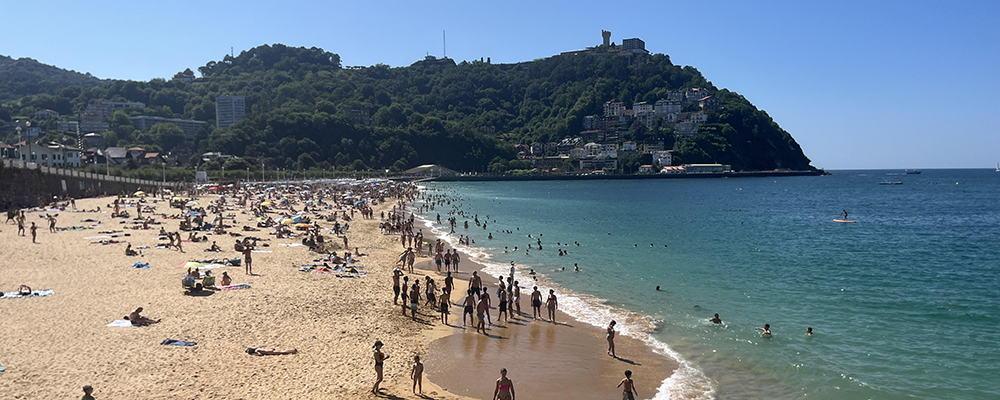
Even after being in San Sebastián for over a week now, I still catch myself being surprised by how beautiful everything is. On the way to the port, I biked along La Concha Beach like I’ve been doing every day, and somehow it still looked just as amazing as the first time I saw it. It was such a good day too, so I had to get some ice cream before getting on the ferry.

We took a ferry around La Concha Bay to Santa Klara Island, and honestly even the boat ride was really fun. Instead of going straight there, the ferry kind of circled the coastline and the island first, which gave us an amazing view of everything. Being out on the water let us really take in the coastline, the beach, and the city from a different perspective. One thing I thought was crazy was seeing people actually swimming from La Concha Beach all the way to the island. I saw a couple of people doing it, and it looked like such a long swim. There were also people hanging out on boats, paddleboarding, kayaking, and just enjoying the weather with friends. 

When we got to the island, I thought it was really beautiful right away. It felt peaceful, but at the same time there were a lot of people there enjoying themselves. As the day went on, more groups arrived, and it definitely seemed like a place locals go to relax, swim, and hang out with friends in good weather. We stayed there for about three hours, and during that time we discussed assignments and our creative project ideas by the water.

For the creative project, everybody can choose whatever format they want as long as it represents their experience here in an authentic way. Some ideas included essays, cooking your favorite meal, music videos, photography collections, podcasts, or artwork. It was cool hearing everyone’s ideas because everybody has taken something different away from this trip.

Besides the discussion, we also had time to relax and cool off in the water. We all jumped in, which felt really nice because it was such a hot day. The island also looked like a really good hiking spot, and honestly, I wish I explored more of it before we left it.

After we took the ferry back, I went back to Hotel Olarain and rested for a little before heading back out later to play basketball and get food afterward. We ended up going to Parte Vieja again, which has probably become my favorite area in San Sebastián. The bars there are amazing, and the food is always so good. I had some pintxos before finally calling it a night.

Going to Santa Klara Island with the group was such a fun experience and definitely one of my favorite days here so far. As our time in San Sebastián is starting to come to an end, I’m realizing how much I’ve enjoyed being here. It honestly feels weird knowing the trip is ending soon because this experience has been amazing. I already know I’d love to come back here someday in the future.

A Lesson Beyond Language

May 20, 2026

Starting off the morning, I did not want to wake up. I knew I had a long day ahead of me, and after almost one week in San Sebastián, the early mornings still had not fully grown on me. At the same time, there was something comforting about the routine I had started to settle into. The calm mornings, long walks through the city, and warmer weather had become familiar. San Sebastián no longer felt entirely new or overwhelming. Taking Spanish classes at Lacunza had become just another part of daily life, something expected rather than unfamiliar.

Like most weekdays, the morning started with class. Walking through the city to school, I noticed how much I had begun paying attention to smaller details like people sitting outside cafés drinking coffee, locals walking quickly to work, and the constant mix of Spanish and Basque written on signs throughout the city. What once felt foreign had slowly started to feel normal.

Later in the day, my group went on our pintxos tour through Parte Vieja, the Old Town of San Sebastián. The narrow streets were full of people moving in and out of restaurants, and every bar seemed packed with plates of food lined across the counter. Pintxos culture feels like something deeply tied to the identity of the city. Even being vegetarian, the tour introduced me to more options that I would’ve never known. It is not just about eating, but about community, conversation, and moving from place to place with friends and family. Walking through Parte Vieja, it became clear how food acts as a form of culture and connection here. Every stop felt different, yet tied together by the same atmosphere of energy and tradition.

However, the most meaningful part of my day came later when we met Stuart for our Basque language session. We met him at Parque de Cristina Enea, which turned out to be one of the best locations possible. It had been one of the hotter days of the week, and sitting in the shade under a tree made the class feel relaxed and informal. Instead of being in a classroom, surrounded by walls and desks, we were learning about Basque culture while sitting in a park that felt alive and peaceful.

Before coming to San Sebastián, I knew very little about the Basque language, or Euskara. I had heard that it was unique, but I did not fully understand what made it so important to the region. Learning about it made me realize that Basque is much more than simply another language people speak. It represents history, resilience, and identity.

Euskara is considered one of the oldest languages in Europe and is especially fascinating because it is not linguistically related to any other known language. Unlike Spanish, French, or English, which belong to larger language families, Basque stands alone. In many ways, it feels mysterious. Hearing Stuart explain this made me think about how unusual it is for a language to survive despite centuries of outside influence and political pressure. Even during difficult periods of history, including the dictatorship of Francisco Franco when Basque culture and language were suppressed, Euskara continued to survive through families and communities who refused to let it disappear.

One thing that surprised me most was learning that some English words have roots connected to Basque through French or Portuguese, including words like bizarre, anchovy, and silhouette. It was unexpected to see a connection between a language spoken in northern Spain and words I use without thinking in English. Small facts like that made the language feel less distant and more connected to the wider world.

The class also made me notice something I had been overlooking throughout my time in San Sebastián: Basque culture is always present, even when it is not obvious. It feels as though it is hidden in plain sight, quietly shaping daily life. You see it in street signs written in both Spanish and Euskara, hear it in conversations around the city, and experience it through traditions, food, and regional pride. Even if you do not immediately notice it as a visitor, it is always there beneath the surface.

By the end of the day, I realized that learning Basque was not really about memorizing words or phrases. It was about understanding the people and history of the place I am living in, even if only temporarily. San Sebastián feels different when you begin to understand the culture beneath the surface. What started as just another long day ended up becoming one of the most meaningful experiences I have had so far.

A look Into Basque Wine

Arrival and Background

On May 26th, 2026, my fellow classmates and I had the privilege to get an inside look at a winery of the name Talai Berri. A bus arrived at Olarain, the residence we are staying at in Donostia, and we drove about twenty minutes towards the countryside right outside of Zarautz. This was my first time ever visiting a winery, so I had no expectations going into it, and I will say it is impossible to put it into words how beautiful it really was. We entered to what seemed like just a modern looking rural house, but the doors were huge and opened up like it was the medieval times. As soon as we got in the lady greeted us instantly and began giving us a background of the winery. One thing I was astonished to learn was the fact that it is a fifth-generation winery and she is looking to pass it down to her family one day, as she has three kids in school at the moment. To confirm to us she was not lying, she pointed towards the wall behind us and showed us pictures of her family since the winery was first established. This was something that truly amazed me because coming from the United States and especially living in Massachusetts, taking on the family business is a dying art. What is the reason? I am not really sure. Maybe it is the fact that people want to pave their own path or find a job that pays higher. One thing for sure is that things are a lot different here in Spain and especially the Basque Country.

Creation and Tasting

After her background of the family business, we had the opportunity to walk downstairs and take an inside look on how the wine is actually made. The area was huge and was filled with these massive metal tanks that stored the wine to keep it cold and fresh, and there was a humungous metal crusher for the grapes. A lot of time and effort goes into making the wine, and the main difference here is that they make it was the upmost quality and effort. After spending about 30-45 minutes learning about the process, we all took a step outside on the balcony and we were blessed with a beautiful view. There was chorizo, cheese, bread, peppers all set up on the table ready to get eaten. It was all beyond tasty and was a pleasant sidekick to the main part… tasting the wine. There was Txakoli a dry white wine produced in the Basque Country, as well as Rose and Vermouth. In that order we began to taste them slowly while we sat along the balcony and talked among ourselves. This is something that Spanish people and especially Basque people are particularly known for. The idea of sitting down for hours either eating or drinking with friends or family without any sort of rush put on your shoulders. An idea that I absolutely love and my friends and I have become well adapted to I believe. The Txakoli was my favorite and was insanely smooth in my opinion. The Rose was also fantastic, just a little more acidic but tasted similar. Lastly the Vermouth was something that I could not get around to. Many of my peers loved it, but for me it had a very strong taste to it, so maybe my pallet has not yet matured! Even after the wine tasting was finished, we sat for more than an hour enjoying our time there while it lasted. The view was amazing and the vineyards all around were windy up and down the hills, and I learned that Spain is actually the 2nd hilliest country in Europe which quite surprised me. I had an absolutely fantastic time and for someone who had never been to a winery, let alone try wine before coming to Spain, it is something everyone should add to their bucket list!

History Above the City: A Day on Mount Urgull

On May 25th, our study abroad group had one of the most memorable days of the trip so far. That morning, everyone was wondering how our afternoon walking up Monte Urgull was going to go due to it being the hottest day yet. We started our day with our usual morning Spanish class at Lacunza from 9:30 a.m. to 1:00 p.m. One thing I have noticed about this program is how different it feels from normal classes back home. Instead of sitting in lecture halls all day, we actually experience the places connected to what we are learning. It makes everything feel more real and interesting. At this point in the trip, the classes have started to feel more natural. During the first few days, speaking Spanish every morning felt forced because I was constantly second-guessing myself. Now I still make mistakes all the time, but I feel much more comfortable participating and understanding conversations. It is cool being able to notice even small improvements after using the language every day.

After class, a few friends and I grabbed lunch at a small taco shop near the school.The weather was perfect, so we sat outside and took our time eating. One thing I have really noticed in San Sebastián is how much slower and more social everyday life feels compared to home. People spend hours sitting outside talking, eating, and enjoying the city instead of rushing everywhere. Even walking through the streets after lunch felt relaxing. The beaches were crowded, people were shopping in the old town, and cafés were packed with locals and tourists.

Later in the afternoon, we met as a group and started the walk up Mount Urgull. At first, it honestly just felt like a scenic hike. We walked through the old part of the city before gradually climbing uphill along shaded paths surrounded by trees and old stone walls. The higher we climbed, the better the views became. Every few minutes someone would stop to take pictures because the scenery was incredible. From different points on the mountain, we could see La Concha Beach, the harbor, and almost the entire city below us.

As we kept walking, our professor started connecting the setting around us to the novels All That Followed and What We Tried to Bury Grows Here. The mountain itself carries a lot of history. Along the paths were old military structures, cannons, and defensive walls that reminded us this city has experienced centuries of conflict and political tension.

When we reached the summit near Castillo de la Mota, we stopped for our seminar-style discussion overlooking the city. Sitting there while talking about Basque identity, nationalism, and political violence made the discussion feel much more meaningful than it would have inside a classroom as we could actually see the history we were talking about. One of the biggest ideas we discussed was how the trauma that still exists because of these conflicts. Before preparing to come on this trip, I honestly knew almost nothing about ETA or the history of the Basque conflict.

In All That Followed, Gabriel Urza focuses less on politics directly and more on how violence shapes family relationships, grief, and identity. During the discussion, we talked about how San Sebastián’s geography almost becomes part of the story itself. Streets, neighborhoods, and public spaces carry memories for the characters. Standing above the city while discussing that idea made it easier to understand because the city suddenly felt much more layered with history instead of just looking like a tourist destination.

The second novel, What We Tried to Bury Grows Here, connected these themes back to the Spanish Civil War and the Franco dictatorship. We also connected both novels to ideas from Basque Country, especially topics like Franco’s suppression of Basque culture and the rise of ETA.

After the discussion ended, we spent some time at the summit just taking in the view before walking back down together. The mood on the way down felt quieter because I think everyone was still thinking about the discussion and everything we had learned. At the same time, there were still lighter moments too. People joked around, took more pictures, and even climbed parts of the castle. Many of us then immediately went to the beach because of how nice the weather was. We played games like volleyball and soccer, sat in the sun, and spent a lot of time in the water. After Spanish class, our hike, and going to the beach, many of us were exhausted and went back to the hotel to rest earlier than most nights and prepare for our next adventure at the Talai Berri Winery.

Overall, it was a great day that not only gave us many fun and memorable moments, but also a new respect and appreciation for the history of San Sebastian and the Basque Country.

Free Weekend at San Sebastian (5/24/26)

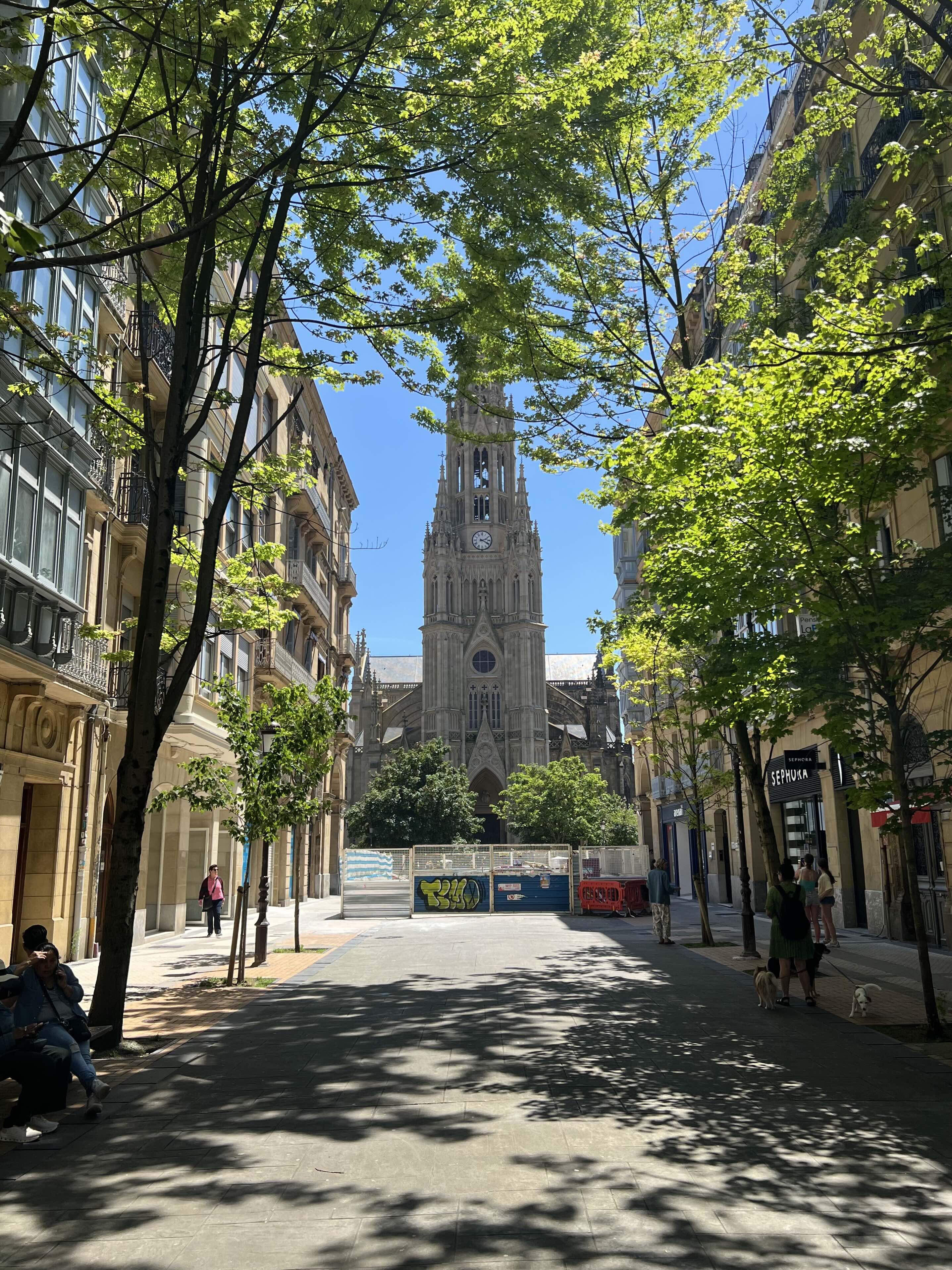
I woke up at around 7:30 this morning as the sunlight peaked through the blinds. I woke up and got dressed for Church, before making my way to the Good Shepherd Cathedral in El Centro. As I biked along the beach on the way to Church, I marveled at the scenic city and coastline that lied before me. The beaches were not yet crowded and the gentle ocean breeze provided a pretty atmosphere. 

Although I have seen the Good Shepherd Cathedral every day since arriving in San Sebastian, I am still amazed by its grand gothic architecture which stands out against the surrounding buildings with Spanish and French architectural influences. The interior of the cathedral is just as breathtaking as its exterior. The cathedral’s organ towers over the main hall, reverberating the hymns and psalms. The walls are decorated with elaborate mosaics while the main alter has a statue of Jesus surrounded by mosaics of the 12 apostles. The cathedral also had other altars and shrines dedicated to the Holy Family, Saint Francis of Assisi, Saint Anthony, and Saint Mary. 

Despite the mass being in a different language, the general procedures were the masses I attended back in the States. I understood about 80 percent of what was happening during the mass although my understanding of their Spanish was around 20 percent.

After mass, I headed towards Gros to try out surfing. I paid for a lesson at a local surf school, Kresala Surf. I was first taught the basic steps in surfing: paddling, catching the wave, popping up, and riding the wave. After the initial introduction on the sand, I made my way into the ocean to practice. With the help of the instructor, I was able to successfully ride the wave on my first attempt. After a couple of successful runs with the instructors assistance, I tried surfing on my own without any success. My main issue was that I could not paddle fast enough to catch a wave without an initial speed boost from the instructor. My improper paddling technique resulted in myself moving too slow and becoming too fatigued. Surfing was an exciting experience that I hope to try again later in the week.

After surfing, I had a hazelnut gelato at Pepperino Gelato to recover my energy. The gelato tasted amazing — the hazelnut flavor had the perfect combination of sweetness and nuttiness — and was better than any gelato that I have had in the States.

Leaving Gros, I embarked on walk along the peninsula near Parte Vieja. Along the peninsula, I stared into the vast turquoise ocean that expanded all the way to the horizon.

As the walk continued, the sun began melting my body and I became desperate for a shady rest spot. Conveniently, just when I need some air conditioning, I stumbled upon the aquarium. When I entered the aquarium, I spotted a sign that offered student discounts — which was when I decided the aquarium would be an ideal spot to retreat from the sunlight for an hour or two. 

Inside the first exhibit of the aquarium was an exhibit about the San Sebastián’s history as a port city. I saw miniature models of the city — as it transformed from a small fishing town into a major port. I was also amazed by the elaborate wooden sailboats that the Basque people once used to sail across the Atlantic Ocean. 

Afterwards, I headed towards the live exhibits where I was able to watch different marine animals. My favorite exhibit was the large fish tank with a glass tunnel passing through the tank. Walking through the tunnel, I felt like was inside the tank itself. I saw different fishes — and even sharks — swim around me in every direction. Other exhibits that I enjoyed was the axolotl tank, since this was my first time seeing one in person. I also enjoyed the crustacean tank with its unique bowl shaped window — making the crustaceans look much bigger than their actual size.

To finish off the day, I went to Parte Vieja for dinner. While in Parte Vieja, I discovered a large bookstore where I purchased some Spanish manga for myself as both a souvenir and a practice tool for my Spanish. 

When exploring Parte Vieja, I noticed how the streets reflect the history of the region. The buildings have both French and Spanish architectural influences. Graffiti covered some buildings with pro-Basque independence declarations — reminding me of the influence by ETA on the Basque Country.

For dinner, I ate at a Michelin recommended bar call Ursola. At the bar, I ordered a steak lintxo and a scallops pintxo. Although both pintxos tasted good, I have tasted better pintxos at different bars and I do not think the bar deserves a Michelin recommendation. 

This free day at San Sebastian has given me the opportunity to further explore the city and immerse myself in their culture.  Through each activity I did, I understood a little but more about the city and the Basque Country.

A Calm Day in San Sebastian

I woke up much later than I normally have this week; around ten o’clock. Normally we have classes, about three hours at Lacunza starting at 9:30 going to 11, then we have a break til 11:30 where me and a few of my friends will get coffee at a cafe right next to Lacunza, and then go back to class until 1. Today was on the weekend though, so I didn’t have to wake up and get ready by any particular time, and was able to catch up on some sleep I had missed throughout the week. I had sort of made it a habit to not get back to the hotel until really late every night because that’s just how the days went–wake up, go to class, get lunch, go to whatever activity was planned, go back to the hotel, and then go to the bars. That last part sounds like an absurd thing to do every day, but the bars in Basque country are very different from other places in the world, being that they are the main places to eat, and instead of drinking being the main focus they are based much more heavily on this. There’s also a huge emphasis on the social aspect at these bars, and even though I wouldn’t say I’m the most talkative person, I still end up chatting with a bunch of strangers every night.

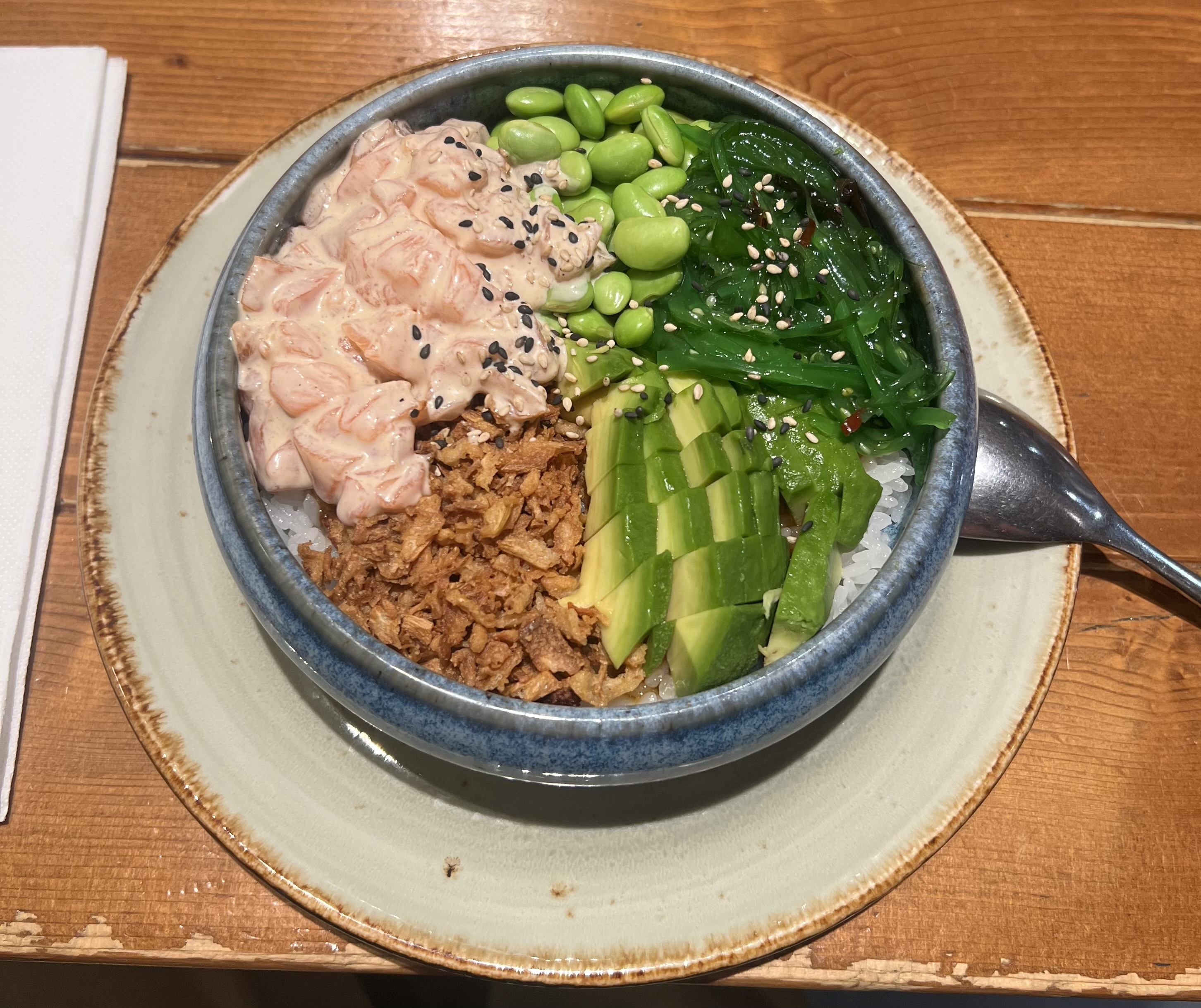
Anyways, after waking up late, my friend and I went out to get something to eat that was close to Lacunza and we ended up going to a Japanese place that I can’t remember the name of. On a side note, it really surprises me how many Japanese restaurants are in San Sebastian, way more than I thought there was going to be. At the restaurant, we tried to read and failed to read the menu because it was as if we were trying to translate Japanese and Spanish at the same time which we weren’t too great at. Luckily we were seated at the bar next to a woman from the area who explained some of the items, gave recommendations and even offered us some of the food she wasn’t going to finish. After going out for food twice a day for a week and meeting a ton of locals, I can definitely say stuff like this isn’t rare at all. The pre-trip readings showed the history and resilience of the Basque people, and the one or two shows I watched gave a snapshot of the place itself, but I really could never have gotten a feel for how hospitable and kind the people are as a whole. We try our best to speak in Spanish, and while I do know some, it is barely enough to order food and hold a conversation, so a lot of time we rely on the patience of the locals or the fact that most just speak English anyways. The food was great, which is the norm for here because it is considered one of the food capitals of the world, having the most Michelin stars per capita out of anywhere in the world.

After leaving the restaurant we met up with a few more of our friends at La Concha beach. We didn’t go in the water, but we did end up playing a bit of soccer and someone who was also visiting San Sebastian joined in. Something about being in the city might just make people more sociable; the slow paced life makes it feel as if there’s not a stress in the world. Even being here for just a week has almost made me fall in love with the lifestyle and city, there’s something about not being rushed in eating, walking, talking, or anything really, that makes you enjoy life that much more. 

After getting sunburnt at the beach, we went to Parte Vieja, which definitely has the best food in our opinion. Combined with that, it seems to have the most bars in a very close area, making it easy to go from one to the next. The reason we go from bar to bar, aside from just changing up the scenery and people, is that most places specialize in one type of pintxo or another, so we’d get a pintxo or two from a bar, a drink, and go on to the next. The night went on like this until we got back at about 12:30, which is pretty good all things considering.

Running Donostia: What a Morning Jog Taught Me About the Basque Way of Life

I’m not a morning person. Anyone who knows me will undoubtedly attest to this. My first reaction was to turn off my alarm and return to sleep when it went off at 7:00 a.m. on a cool May morning in San Sebastián. However, I got out of bed, put on my running shoes, and headed out the door thanks to the light streaming through the curtains and the soft buzz of the city outside.

My path was straightforward: I started at our hotel, went to the waterfront, and then walked the entire length of La Concha beach, back and forth. That sounds like a typical morning jog on paper. It was quite different in reality. Green mountains rise dramatically from the water’s edge on both sides of La Concha, which translates to “the shell” in Spanish. It goes along a broad, smooth promenade with elaborate iron railings that, in the early morning, glows in a gentle, gray-gold light that I can only characterize as cinematic. At seven in the morning, San Sebastián doesn’t look genuine. It appears to have been painted.

Yet it wasn’t the scenery that most impressed me. The people were to blame.
When I go for a morning run at home, I wear headphones, look forward, and am essentially alone. Everybody lives in their own universe. This step was not the same as the previous one. The promenade was already busy, but lively, with a cast of people who were all from the area. With their hands clasped behind their backs, elderly men in berets strolled slowly in pairs and conversed with the carefree ease of those who had nothing more important to do. Near one of the benches, a group of elderly women stretched while chuckling over something. With peaceful patience, fishermen dropped their lines into the bay while leaning against the railing at the far end. Compared to runners at home, even the other runners appeared less sealed off. I’m just not used to the nods, quick conversations, and recognition of shared space.

Marti Buckley states in the Basque Country that “conceiving of a relationship or a celebration without food is truly impossible for a Basque,” and that social mealtimes are the focal point of the Basque day, drawing people out of their houses and into communal areas. This got me thinking. That morning, as I was strolling along the promenade, I began to believe that food isn’t the only thing that functions in this way. It’s actually the city. It appears that San Sebastián was built for public life. Because of its width, the promenade encourages lingering. Facing the water are the benches. The bars have early hours. The physical design of the space is predicated on the idea that you will want to spend time outdoors with other people.

Public space is something you go through at home. It is something you live in here. The promenade is a destination rather than a road. The people I went by weren’t using it to travel somewhere else. They were there because it’s just a pleasant way to spend a morning in that light, with the bay in front of them and the mountains behind.

I made a stop at a little, already-open and packed café off the seafront on my way back. Like everyone else, I ordered a café con leche at the bar and stood there sipping it while observing the street. That was €1.20. With the intensity of someone reading a legal document, the man beside me read a newspaper. With the efficiency of someone who has made 10 thousand coffees and doesn’t see the need to make the eleventh, the barista walked behind the counter. There was no one using a phone. No one was in a hurry. Even though it was a typical May morning in San Sebastián, I felt more in the moment after finishing my coffee than I had in months.

What the jog taught me is something that is difficult to understand from a book or video but becomes clear when you are actually walking around a location: that culture is not limited to museums, dining establishments, or historical monuments. It has to do with how quickly individuals move. It depends on whether or not strangers look each other in the eye. It has to do with how a city sets up its public areas and what it allows you to do there. San Sebastián urges you to take a moment to calm down, gaze out at the bay, stand at a bar and sip your coffee, and simply be somewhere.

Throughout the program, we have discussed Basque identity, its connection to language, cuisine, and a lengthy history of oppression and struggle. That background has all been crucial. However, it wasn’t until I was running along La Concha at seven in the morning and saw an elderly man wearing a beret feed bread to pigeons with the gravity of someone carrying out a sacred duty that I truly experienced any of it. Not all that this location has endured has happened by chance. It has endured because its residents determined, generation after generation, that the common joys of everyday existence were worth preserving.
I’ll probably sleep in tomorrow. However, I’m pleased I didn’t today.

Pintxos, Patience and Personal Growth

Being the youngest in a big family means I grew up watching my older sisters travel the world, leaving me behind, making me crave the taste of traveling and new cultures. But I knew from a young age that I would study abroad just like them, following in their footsteps. When I found out about this program, I jumped on the opportunity right away. And when we arrived in San Sebastían, I could finally take this weight off my shoulders of fulfilling my long-time goal of studying abroad because I finally made it.

When we first arrived here, I did not realize how different lifestyles are here compared to home. As someone who stresses the little things and likes an orderly schedule, like most Americans, I had to adjust to a calm mindset and go with the flow like the rest of society here. It is now Friday morning, almost a week since I left home and safe to say this whole trip thus far, I have become an expert at going with the flow.

Even though I’ve been more relaxed with schedules this trip, Thursday was more of an organized day for me. I enjoy a structured routine in the morning. Wake up, get ready, grab some breakfast, and bike to class. Normally I dread the wake up for class at home, but here I look forward to going to class. I get to see the beautiful views each morning as I pedal my way to Lacunza where I have met many people from all over the world like Germany, France and Switzerland, all trying to learn Spanish. The class is such a great environment and makes everyone want to engage and enhance their Spanish. On this day though, we took what we learned into the shops next door with our teacher and pointed out what each type of clothing we saw was like zapatillas, camisetas, y pantalones.

After class I headed straight to my pintxo tasting tour. Might be my new favorite food now. We first went to Antonio’s Bar who must have a high demand with a line out the door. And I can say that the wait is definitely worth it. I don’t even know how many pintxos we had, but everything just melted in my mouth so delectably. After hitting two more spots in Centro, including the oldest pintxo bar in San Sebastían, I was stuffed, but always have room for gelato. Everything was so fresh. I am used to eating a lot of seafood growing up on the jersey shore, so a lot of the food felt comfortable, especially eating with a large group of us, felt like home. But this seafood was on a whole new level I’ve never experienced before.

Pre-departure of coming here, we were required to read Marti Buckley’s two cookbooks about the Basque country and Pintxos. After the pintxos, we were able to meet her and talk to her about her life and learned more about the cuisine that this city brings along with beauty. I gained a newfound appreciation for the smallest details that go into making these bite sized meals. In America, we are able to eat anything at any time instead of waiting for the proper season. But here you must wait for that time of year for harvest. Like in August it is Squid season, but now it is produce season, and I was able to try their wonderful asparagus. That is another reason why the food here is so special because you can’t get it anywhere else or anytime you want, you must be patient and enjoy what fresh food you have in front of you while you can. Marti Buckely puts all of this and more in her books and describes the culture so preciously and even more so in person.

San Sebastían is a very walkable city, 20k steps a day more or less so far, so when I had to walk back to my bike afterwards, it felt short compared to day 1. As the days go on, I’m becoming more familiar with my surroundings. Usually at home I would be stressed out about wasting time walking, but here I soak in everything while I can, taking my time and being in the moment because I know it won’t last forever, just like the produce.

This beautiful place came with beautiful weather as well, so my friends and I decided to hit the beach even though it was already 6pm and our phones were all dead. This truly allowed us to be fully immersed in the moment. Watching the people lay around with their dogs and swimming in the clear blue water, I realized how the simplest things like the warmth of the sun can bring everyone together even when we are a language apart. These small things are what I am going to bring back home with me and look for everywhere I go, bringing a reminder of this place with me, making it more special than it already is.

If I have learned anything during my time here so far and will continue to learn all next week, it is how precious time is. If it’s waiting in line for pintxos or waiting for a whole season for some squid, be in the moment while you wait. Enjoy one’s company, get out of your comfort zone and stop stressing about a schedule. These small things are what makes a moment matter. This trip taught me more about myself and my independence than anything else ever did. Independence is a big thing in growing up, but I realized here that it does not have to be scary, instead just take everything one at a time, enjoying everything while you can before a new phase of life changes everything once again. And who knows, maybe that the next phase of life will lead me back here.

Blending in Through Basque

Getting out of bed to go to class is arguably the hardest part of the day. The sun is shining and the temperature is perfect, yet we have to sit inside for what feels like forever. Although, it only feels this way because we know that spontaneous adventure calls for us outside.

For example, in class that morning we had no idea we would end up in a Basque bar at one in the morning endearing ourselves to the locals.

The day truly began after class with our pintxo tour. We started off at Bar Antonio, where words can barely describe the taste of perfection here. Professor Zabalbeascoa ordered us an array of bites, primarily consisting of seafood and some classic dishes. From shrimp ravioli and oxtail to fresh in season asparagus, every bite was perfect. My favorite was the tuna; it ever so perfectly melts in your mouth and is so fresh.

Something I admire here is the quality and passion for food. Every dish is served in season for the product, allowing the flavors to be in their prime. In particular, the asparagus we had at Bar Antonio was so incredibly delicious, primarily due to the season for asparagus being March through May. Not only does the freshness play a huge role but the preparation made it even better.

After Bar Antonio we experienced two more places and in one we tried what is understood to be the first ever pintxo. This bite consists of two olives, one salted anchovy, and three guindilla pickled peppers. Hearing and seeing these ingredients one may expect for the spice level to be near nonexistent, yet this bite packs a punch. As someone who cannot handle spice (in the slightest bit at all) and is skeptical of olives, this bite had me breaking a sweat. However, I found myself enjoying the bite and even more so enjoying the feeling of stepping out of my comfort zone.

After eating an impossible amount of pintxos we headed over to meet Marti Buckley. I was very excited to listen to her speak here in San Sebastián. I never listen to podcasts as I find them boring or hard to follow, yet I love Buckley’s podcast. Her voice is so soothing, and she speaks in a way that can engage any audience. We met her at Plaza de Okendo, where we were surrounded by the bullet holes on the buildings from the Spanish Civil War. Buckley explained to us her calling to Spain and left us with some wise words. She reminded us to find and follow our passions, adding that money isn’t necessarily key to a perfect life. I’ve noticed that this lifestyle she lives and described is one that many follow here. Vastly different from the fast paced, money-orientated American lifestyle.

After a wonderful talk with Marti Buckley the heat drove us to the beach. The waves and sun were the perfect environment for a pre-dinner siesta. For dinner and drinks we started off at Bar Antzara for the delicious ham and cheese croquette and caesar salad. Although this was delicious, our night did not end here. We then headed over to La Mera Mera to keep the adventure going. It wasn’t until we went to Bar Restaurante Platero when we became friends with the locals.

It all began when we entered, “Kaixo!” we said as we approached the bar top. Upon hearing this the locals and bartenders smiled, becoming welcoming and warm towards our group. We began to order more and engage with the locals. In all honesty, this is the most Spanish I have probably ever spoken. In one night, with only one word, we met countless people. We learnt backstories, new Spanish and Basque words, and lifestyles of the people around us. This night was the most memorable one yet, the one that allowed us to understand those here in San Sebastián.

Exploring Parte Vieja

It has been 3 days since I landed in San Sebastian, and I have been enjoying the great weather, wonderful food, and splendid views. However, after a sleepless first flight and uncomfortable second flight, I had been left feeling tired, exhausted, and just out of it, even after getting some proper sleep in my hotel room for two days. That is why on Wednesday morning I decided to sleep a little later than usual and attempt to regain my lost energy. I got out of bed at around 11:00 in the morning, got dressed, and began heading out into the city to meet up with my pintxo tasting group. I took my time walking thorough the city, enjoying the wonderful sight of the beach and the ocean before I began exploring some of the numerous shops and Cafés. 

Eventually I made it to the old part of San Sebastian where I was to meet up with my pintxo tasting group, but I had arrived with plenty of time to spare. I walked into this sweet and quaint little store that was filled with fresh produce. I walked around the store a bit looking at all the fruits, veggies, beans, some jars of jam, and much more. I eventually decided to buy a nice big water bottle for the day. The old lady at the counter thankfully spoke English, though I did try to and was sweet, even offering me some extra tea in a little cup and another free drink at another of her stores. I have yet to visit it and get that free drink, but I will though. 

Anyways, after I finished paying for everything, I went down to Haizea to meet up with the rest of the pintxo tasting tour group. I was early, the first one there besides Mr. Zabalbeascoa. As I waited for the rest of the group to arrive, I could feel the anticipation and excitement start to well up inside me. I had already tried some pintxos beforehand but knowing that Mr. Zabalbeascoa was going to be ordering the best pintxos for us to try had me feeling extra gluttonous. I had to pull out my phone and start playing Angry Birds just to calm down a little bit. Eventually, everyone pulled up and we began feasting on pintxos. We had the classic pintxo, Gilda, which surprised me with its strong and acidic aftertaste, but I still enjoyed it. We had another bacalao based pintxo before we moved onto bar hopping. We had so many pintxos, and each one was good. By the time we had finished the tour, we were all totally stuffed. I had to go play some basketball just to feel less like a big back.