I’m not a morning person. Anyone who knows me will undoubtedly attest to this. My first reaction was to turn off my alarm and return to sleep when it went off at 7:00 a.m. on a cool May morning in San Sebastián. However, I got out of bed, put on my running shoes, and headed out the door thanks to the light streaming through the curtains and the soft buzz of the city outside.
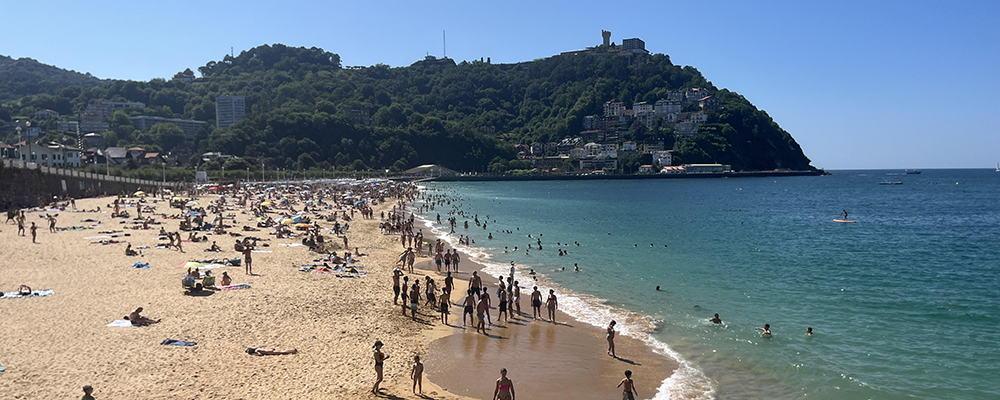
My path was straightforward: I started at our hotel, went to the waterfront, and then walked the entire length of La Concha beach, back and forth. That sounds like a typical morning jog on paper. It was quite different in reality. Green mountains rise dramatically from the water’s edge on both sides of La Concha, which translates to “the shell” in Spanish. It goes along a broad, smooth promenade with elaborate iron railings that, in the early morning, glows in a gentle, gray-gold light that I can only characterize as cinematic. At seven in the morning, San Sebastián doesn’t look genuine. It appears to have been painted.
Yet it wasn’t the scenery that most impressed me. The people were to blame.
When I go for a morning run at home, I wear headphones, look forward, and am essentially alone. Everybody lives in their own universe. This step was not the same as the previous one. The promenade was already busy, but lively, with a cast of people who were all from the area. With their hands clasped behind their backs, elderly men in berets strolled slowly in pairs and conversed with the carefree ease of those who had nothing more important to do. Near one of the benches, a group of elderly women stretched while chuckling over something. With peaceful patience, fishermen dropped their lines into the bay while leaning against the railing at the far end. Compared to runners at home, even the other runners appeared less sealed off. I’m just not used to the nods, quick conversations, and recognition of shared space.
Marti Buckley states in the Basque Country that “conceiving of a relationship or a celebration without food is truly impossible for a Basque,” and that social mealtimes are the focal point of the Basque day, drawing people out of their houses and into communal areas. This got me thinking. That morning, as I was strolling along the promenade, I began to believe that food isn’t the only thing that functions in this way. It’s actually the city. It appears that San Sebastián was built for public life. Because of its width, the promenade encourages lingering. Facing the water are the benches. The bars have early hours. The physical design of the space is predicated on the idea that you will want to spend time outdoors with other people.
Public space is something you go through at home. It is something you live in here. The promenade is a destination rather than a road. The people I went by weren’t using it to travel somewhere else. They were there because it’s just a pleasant way to spend a morning in that light, with the bay in front of them and the mountains behind.
I made a stop at a little, already-open and packed café off the seafront on my way back. Like everyone else, I ordered a café con leche at the bar and stood there sipping it while observing the street. That was €1.20. With the intensity of someone reading a legal document, the man beside me read a newspaper. With the efficiency of someone who has made 10 thousand coffees and doesn’t see the need to make the eleventh, the barista walked behind the counter. There was no one using a phone. No one was in a hurry. Even though it was a typical May morning in San Sebastián, I felt more in the moment after finishing my coffee than I had in months.
What the jog taught me is something that is difficult to understand from a book or video but becomes clear when you are actually walking around a location: that culture is not limited to museums, dining establishments, or historical monuments. It has to do with how quickly individuals move. It depends on whether or not strangers look each other in the eye. It has to do with how a city sets up its public areas and what it allows you to do there. San Sebastián urges you to take a moment to calm down, gaze out at the bay, stand at a bar and sip your coffee, and simply be somewhere.
Throughout the program, we have discussed Basque identity, its connection to language, cuisine, and a lengthy history of oppression and struggle. That background has all been crucial. However, it wasn’t until I was running along La Concha at seven in the morning and saw an elderly man wearing a beret feed bread to pigeons with the gravity of someone carrying out a sacred duty that I truly experienced any of it. Not all that this location has endured has happened by chance. It has endured because its residents determined, generation after generation, that the common joys of everyday existence were worth preserving.
I’ll probably sleep in tomorrow. However, I’m pleased I didn’t today.