Being the youngest in a big family means I grew up watching my older sisters travel the world, leaving me behind, making me crave the taste of traveling and new cultures. But I knew from a young age that I would study abroad just like them, following in their footsteps. When I found out about this program, I jumped on the opportunity right away. And when we arrived in San Sebastían, I could finally take this weight off my shoulders of fulfilling my long-time goal of studying abroad because I finally made it.
When we first arrived here, I did not realize how different lifestyles are here compared to home. As someone who stresses the little things and likes an orderly schedule, like most Americans, I had to adjust to a calm mindset and go with the flow like the rest of society here. It is now Friday morning, almost a week since I left home and safe to say this whole trip thus far, I have become an expert at going with the flow.
Even though I’ve been more relaxed with schedules this trip, Thursday was more of an organized day for me. I enjoy a structured routine in the morning. Wake up, get ready, grab some breakfast, and bike to class. Normally I dread the wake up for class at home, but here I look forward to going to class. I get to see the beautiful views each morning as I pedal my way to Lacunza where I have met many people from all over the world like Germany, France and Switzerland, all trying to learn Spanish. The class is such a great environment and makes everyone want to engage and enhance their Spanish. On this day though, we took what we learned into the shops next door with our teacher and pointed out what each type of clothing we saw was like zapatillas, camisetas, y pantalones.
After class I headed straight to my pintxo tasting tour. Might be my new favorite food now. We first went to Antonio’s Bar who must have a high demand with a line out the door. And I can say that the wait is definitely worth it. I don’t even know how many pintxos we had, but everything just melted in my mouth so delectably. After hitting two more spots in Centro, including the oldest pintxo bar in San Sebastían, I was stuffed, but always have room for gelato. Everything was so fresh. I am used to eating a lot of seafood growing up on the jersey shore, so a lot of the food felt comfortable, especially eating with a large group of us, felt like home. But this seafood was on a whole new level I’ve never experienced before.
Pre-departure of coming here, we were required to read Marti Buckley’s two cookbooks about the Basque country and Pintxos. After the pintxos, we were able to meet her and talk to her about her life and learned more about the cuisine that this city brings along with beauty. I gained a newfound appreciation for the smallest details that go into making these bite sized meals. In America, we are able to eat anything at any time instead of waiting for the proper season. But here you must wait for that time of year for harvest. Like in August it is Squid season, but now it is produce season, and I was able to try their wonderful asparagus. That is another reason why the food here is so special because you can’t get it anywhere else or anytime you want, you must be patient and enjoy what fresh food you have in front of you while you can. Marti Buckely puts all of this and more in her books and describes the culture so preciously and even more so in person.
San Sebastían is a very walkable city, 20k steps a day more or less so far, so when I had to walk back to my bike afterwards, it felt short compared to day 1. As the days go on, I’m becoming more familiar with my surroundings. Usually at home I would be stressed out about wasting time walking, but here I soak in everything while I can, taking my time and being in the moment because I know it won’t last forever, just like the produce.
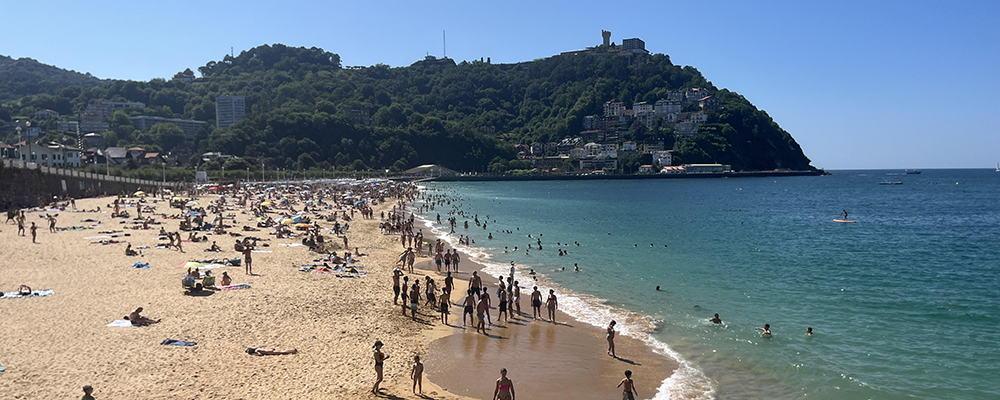
This beautiful place came with beautiful weather as well, so my friends and I decided to hit the beach even though it was already 6pm and our phones were all dead. This truly allowed us to be fully immersed in the moment. Watching the people lay around with their dogs and swimming in the clear blue water, I realized how the simplest things like the warmth of the sun can bring everyone together even when we are a language apart. These small things are what I am going to bring back home with me and look for everywhere I go, bringing a reminder of this place with me, making it more special than it already is.
If I have learned anything during my time here so far and will continue to learn all next week, it is how precious time is. If it’s waiting in line for pintxos or waiting for a whole season for some squid, be in the moment while you wait. Enjoy one’s company, get out of your comfort zone and stop stressing about a schedule. These small things are what makes a moment matter. This trip taught me more about myself and my independence than anything else ever did. Independence is a big thing in growing up, but I realized here that it does not have to be scary, instead just take everything one at a time, enjoying everything while you can before a new phase of life changes everything once again. And who knows, maybe that the next phase of life will lead me back here.
Category Archives: Uncategorized
Blending in Through Basque
Getting out of bed to go to class is arguably the hardest part of the day. The sun is shining and the temperature is perfect, yet we have to sit inside for what feels like forever. Although, it only feels this way because we know that spontaneous adventure calls for us outside.
For example, in class that morning we had no idea we would end up in a Basque bar at one in the morning endearing ourselves to the locals.
The day truly began after class with our pintxo tour. We started off at Bar Antonio, where words can barely describe the taste of perfection here. Professor Zabalbeascoa ordered us an array of bites, primarily consisting of seafood and some classic dishes. From shrimp ravioli and oxtail to fresh in season asparagus, every bite was perfect. My favorite was the tuna; it ever so perfectly melts in your mouth and is so fresh.
Something I admire here is the quality and passion for food. Every dish is served in season for the product, allowing the flavors to be in their prime. In particular, the asparagus we had at Bar Antonio was so incredibly delicious, primarily due to the season for asparagus being March through May. Not only does the freshness play a huge role but the preparation made it even better.
After Bar Antonio we experienced two more places and in one we tried what is understood to be the first ever pintxo. This bite consists of two olives, one salted anchovy, and three guindilla pickled peppers. Hearing and seeing these ingredients one may expect for the spice level to be near nonexistent, yet this bite packs a punch. As someone who cannot handle spice (in the slightest bit at all) and is skeptical of olives, this bite had me breaking a sweat. However, I found myself enjoying the bite and even more so enjoying the feeling of stepping out of my comfort zone.
After eating an impossible amount of pintxos we headed over to meet Marti Buckley. I was very excited to listen to her speak here in San Sebastián. I never listen to podcasts as I find them boring or hard to follow, yet I love Buckley’s podcast. Her voice is so soothing, and she speaks in a way that can engage any audience. We met her at Plaza de Okendo, where we were surrounded by the bullet holes on the buildings from the Spanish Civil War. Buckley explained to us her calling to Spain and left us with some wise words. She reminded us to find and follow our passions, adding that money isn’t necessarily key to a perfect life. I’ve noticed that this lifestyle she lives and described is one that many follow here. Vastly different from the fast paced, money-orientated American lifestyle.
After a wonderful talk with Marti Buckley the heat drove us to the beach. The waves and sun were the perfect environment for a pre-dinner siesta. For dinner and drinks we started off at Bar Antzara for the delicious ham and cheese croquette and caesar salad. Although this was delicious, our night did not end here. We then headed over to La Mera Mera to keep the adventure going. It wasn’t until we went to Bar Restaurante Platero when we became friends with the locals.
It all began when we entered, “Kaixo!” we said as we approached the bar top. Upon hearing this the locals and bartenders smiled, becoming welcoming and warm towards our group. We began to order more and engage with the locals. In all honesty, this is the most Spanish I have probably ever spoken. In one night, with only one word, we met countless people. We learnt backstories, new Spanish and Basque words, and lifestyles of the people around us. This night was the most memorable one yet, the one that allowed us to understand those here in San Sebastián.
Exploring Parte Vieja
It has been 3 days since I landed in San Sebastian, and I have been enjoying the great weather, wonderful food, and splendid views. However, after a sleepless first flight and uncomfortable second flight, I had been left feeling tired, exhausted, and just out of it, even after getting some proper sleep in my hotel room for two days. That is why on Wednesday morning I decided to sleep a little later than usual and attempt to regain my lost energy. I got out of bed at around 11:00 in the morning, got dressed, and began heading out into the city to meet up with my pintxo tasting group. I took my time walking thorough the city, enjoying the wonderful sight of the beach and the ocean before I began exploring some of the numerous shops and Cafés.
Eventually I made it to the old part of San Sebastian where I was to meet up with my pintxo tasting group, but I had arrived with plenty of time to spare. I walked into this sweet and quaint little store that was filled with fresh produce. I walked around the store a bit looking at all the fruits, veggies, beans, some jars of jam, and much more. I eventually decided to buy a nice big water bottle for the day. The old lady at the counter thankfully spoke English, though I did try to and was sweet, even offering me some extra tea in a little cup and another free drink at another of her stores. I have yet to visit it and get that free drink, but I will though.
Anyways, after I finished paying for everything, I went down to Haizea to meet up with the rest of the pintxo tasting tour group. I was early, the first one there besides Mr. Zabalbeascoa. As I waited for the rest of the group to arrive, I could feel the anticipation and excitement start to well up inside me. I had already tried some pintxos beforehand but knowing that Mr. Zabalbeascoa was going to be ordering the best pintxos for us to try had me feeling extra gluttonous. I had to pull out my phone and start playing Angry Birds just to calm down a little bit. Eventually, everyone pulled up and we began feasting on pintxos. We had the classic pintxo, Gilda, which surprised me with its strong and acidic aftertaste, but I still enjoyed it. We had another bacalao based pintxo before we moved onto bar hopping. We had so many pintxos, and each one was good. By the time we had finished the tour, we were all totally stuffed. I had to go play some basketball just to feel less like a big back.
A New Pace and Place
It has always been a dream to travel the world, as it is for many people. I love experiencing what the world has to offer because I believe that people learn best when they are out of their comfort zones. Being from Washington State and attending school in Massachusetts was already a major adjustment for me. I had to learn differences in culture, social norms and simple courtesies between West Coast to East Coast. But I wanted to do more and experience something even further outside my comfort zone. Traveling from Washington to the Basque country sounded thrilling but also unfamiliar. It was not just across the United States but it meant a different language lifestyle, and a new level independence.
Travel
The journey itself immediately pushed me outside what felt familiar. A long day of travel and feeling so turned around. Between the time zones the layovers, the lack of sleep all just began all the emotions of excitement mixed with nervousness. Trying to adjust to the time change of nine hours was a struggle in itself but including the eleven hours of flying in top of that was a whirlwind of emotions. This was my first time traveling internationally alone and the stress of not knowing how to navigate the airport for our layover and being separated from my friend. For the first time I felt very disconnected in many ways, not only for home but also because of my language barriers.
Pace of life
When we finally arrived where we were staying it was a relief to say the least. However we soon realized we were stepping into a completely different pace of life. In the States it is so easy to get food whenever, 24 hour McDonald’s and many options. Don’t get me wrong there is a slew of options in the Basque Country. But the entire city is closed from 1 to 4. And to add to this Sundays most aren’t open as well. Meals are very important here but also being a human and not an employee the whole day as well. This break is spent on the streets with others. But after traveling for a whole day we just wanted to have a nice meal and sleep.
The streets were crowded and busy but not like a normal city street. Also peaceful and graceful as the waves were crashing on our walk to find food. Having no idea where to eat we had stumbled to a little spot by ourselves to eat. A whole new way of ordering and paying with the realized nervousness to order in broken Spanish. But this discomfort was all a part of the learning and It got easier as the sever kept asking us questions to answer back. We felt as if we were out of place because the whole city wasn’t eating. They were enjoying company of others in their break. But we were fortunate to find a place that served us and were accepting of us speaking our jumbled Spanish. The first day taught me a lot through the discomfort and not avoid intimidating things in a new country.
An Unexpected Morning in San Sebastián
“Like the dead,” he said, “…you will sleep like the dead.” Professor Zabalbeascoa was right. I woke up to my alarm at 7:15, feeling disoriented but alert. I gathered myself and went
downstairs to eat breakfast with everyone.
We were supposed to be at our Spanish classes at 8:45 to have time to be placed at an adequate level. To be great students, we decided to leave breakfast ten minutes earlier than we could have, leaving room for error. What we didn’t realize was how many errors we could possibly make. After finding and unlocking the bikes we were assigned, we walked outside and test rode them. Avery said hers was too tall, so we swapped bikes to test the difference. We decided that they fit us both just right, and being in a rush, we rode off with everyone else.
Even though San Sebastian has implemented bikes into people’s daily commutes, it was still nothing like what I expected it to be. Not having ridden a bike in many years, I started questioning if I ever even learned how to. Balancing in a two-foot-wide lane took practice, especially while watching for pedestrians, cars, and sudden lane changes all at once. We ride off in a single-file line, trusting the line leader who held up their phone for directions. The rest of us had no idea where we were going.
When we finally thought we arrived, we made sure to lock up our bikes like we were told. Unfortunately, when we swapped bikes, we forgot to switch our keys as well. After freaking out for a couple of seconds, I improvised and shared a lock with a classmate. The location did not look welcoming, with a small sign that said Lacunza on a fence. After discovering the entrance and asking around, it seemed to be the wrong Lacunza. Devastated, we were forced to turn around and keep looking.
With every traffic light we passed, there was a good chance we’d lose someone from our line. As the bike lights flicker from yellow to red, I slow down, willing to comply with the rules of the road, while almost everyone else rides right past me, leaving a disgusted look on the pedestrians’ faces. Specifically, I watched them ride through, cutting off a man who was holding some papers, about to smack one of them, screaming “rojo.” While I felt proud for sticking to the rules, I had now lost everyone else. I panicked but pulled out my phone to look up the directions, trying to memorize how many streets I needed to pass before stopping again to check for the next turn. Waiting at the last red light, I started realizing how quickly I had handed over the responsibility to everyone else. None of us knew the city, but following the group felt easier than trusting myself.
After many wrong turns, faulty bikes, wrong addresses, and getting lectured by locals for riding on the sidewalk, we finally made it to class… thirty-five minutes late.
After our classes, we headed out for lunch. Attempting to order in Spanish at the restaurant was humbling as I was quickly shut down after the servers realized that I was not fluent. Feeling disappointed in my long-learned language abilities, I replied to them back in English, as they tried (just as much as I did) to be accommodating.
I ordered mosto, surprised to see that what I originally thought were grapes were two green olives floating on the ice cubes. A little repelled, I took a sip. It tasted like plain grape juice while still smelling like olives. Like everything else that morning, it was unfamiliar enough to unsettle me.
Two Days to Fall in Love
I’ve learned it takes two days and four phases to fall in love. That is, at least, my experience thus far with San Sebastián. Although I’ve spent less than 60 hours in the Basque Country, I feel I’ve learned far more than can be measured about España, Basque culture, history, and, of course, myself.
The first phase of my self-proclaimed “four phases of love”: infatuation. Upon my flight’s descent into Bilbao, I stared in complete awe at the scenes I was met with. Although I had learned of the Basque Country through various forms of media, devoted much of my paychecks to crafting an ideal wardrobe (knowing I would never truly find perfection in it), and excitedly daydreamed of this trip and its destination for months, I was suddenly met with an overwhelming sense of realization that I was in the presence of something incredibly grand and beautiful. At this moment, I possessed no fear of any difficulties that might reveal themselves to me on this trip. There seemed to be no wrong with this beautiful region. As an Oregon native and Hawaii frequenter, I felt great comfort in the mountains, greenery, and water displayed before me. I was excited to create a new relationship with such a beautiful place. This feeling came effortlessly, as I observed a land that looked like it carried no flaws.
Soon after deplaning, my rose-colored glasses began to come off. The next phase–the reality check–began to set in. Although still full of excitement, I quickly became aware of the real difficulties associated with being in a foreign country with minimal understanding of the culture, language, and geography. Whether that came from failing multiple times to buy a bus ticket from the airport’s machine or getting judgmental looks from Basque locals as my friends and I wandered San Sebastián in our “jeans and a cute top” outfits searching for dinner at the ripe hour of 5:00, about four hours before everyone else eats, or from my inability to communicate with just about anyone through my very broken Spanish, I was quickly humbled by reality. Regret began to set in as I questioned if the whole trip would feel as humiliating and culturally isolating as it did in those first few hours.
Over the next two days, a shift occurred. All of a sudden, I found myself becoming immersed in Basque life, whether through the growing language skills I have begun developing in class and practicing throughout the city, a better understanding of the layout and culture of San Sebastián, or an overall increasing sense of familiarity with this place. Although it feels impossible to avoid feelings of fear and self-doubt at times due to my continued unfamiliarity with both the language and culture, those emotions slowly began to be replaced with curiosity, comfort, and admiration. What once felt overwhelming started to feel exciting, and the city that initially intimidated me soon became the very thing drawing me in. I feel this is where I have truly begun to develop a love for this city and the region surrounding it.
I have begun to feel a deeper and fuller sense of appreciation for the Basque Country. Although I cannot credit myself in any way as experienced enough in this region to call myself familiar with it, I have learned to find beauty in the “imperfections” that present themselves to me. My original sense of butterflies still exists, but it is overshadowed by a profound, comforting certainty. I can truly say I have experienced difficulties and despite any hardships in my foreigner reality, I love it all anyway. Earlier today, I found myself successfully ordering a meal entirely in Spanish, and later laughing through awkward linguistic miscommunications with a server instead of shrinking from them. Today, we went up Monte Igueldo, and as I looked over the elevated ledge at the landscape before me, I was hit with my initial sense of awe. Suddenly, beaches are beaches again, mountains are mountains, people are people, and my expectations of San Sebastián no longer feel far from reality.
Perhaps these phases are not as separate as I originally imagined them to be. Maybe infatuation, harsh reality, growth, and appreciation can all exist simultaneously, constantly overlapping and reshaping one another. And with nearly two more weeks left in San Sebastián, I have a feeling this version of love–one grounded in both awe and reality–will continue to grow and strengthen day by day, and year by year, even after I return home.
Day 1: Sticking out like a sore thumb.
I am no stranger to being in a new country, on my own. I’ve lived in a small town in Canada my entire life, however in order to pursue lacrosse I had to move to the United States. Obviously, there definitely aren’t as many differences between Canada and the U.S.A as there are between Canada and Spain. I still assumed that when coming here I would find the adjustment to be easy, as I had already made a similar adjustment for nine months.
When we first arrived on Sunday, I had my first of many experiences feeling like I was sticking out like a sore thumb. A completely broken, and severed thumb for that matter. My lack of Spanish language comprehension and speaking proved to be more of a problem than I thought. While, most people here speak English, they respond to you in a manner of disrespect and rightfully so. In Canada and the USA when tourists visit we expect them to know our language, so why shouldn’t we be expected to speak theirs?
By 5pm we were ready to hit the town. To most of western society this may sound like a reasonable time to go get dinner and cocktails with your friends. And as naive as any other average tourist we assumed it to be the same here. Dressed in our nice dinner clothes we started our walk. I was heavily distracted by all the stares we were getting. I tried to ignore this, but the paranoia grew worse when I was barely able to order my drinks. Let alone the confused look we got we asked to order food.
We ended up calling the night early, and going to sleep by 7:30. This morning is when I discovered why all of our interactions were less than ideal. Turns out, average dinner time here is around 9pm. Little did I know most establishments close from the hours of 1-4 and kitchens aren’t typically reopened until about 7pm. So we were off by a few hours. When our night was ending most people was just beginning.
Additionally, this morning made me realize the importance of language. When I moved to the States I had no problem adjusting because I wasn’t stripped of my own culture. Apart from a few mannerisms, everyday life was pretty similar and most importantly I could speak the same language. Ashamed of my inability to speak Spanish I wasn’t really able to enjoy my night. I felt almost unworthy of appreciating my surroundings. I have learned that it isn’t until you are put in a situation where you are stripped of your own culture that you can truly appreciate another. When people suggest embracing the culture when you travel, it’s not just a cliche saying. It really is important. After one beginners Spanish class I felt like I was able to relate to the locals more. While I really only learned basic expressions, like how to say my name and where I lived, it was a start. A start that gave me the ability to really connect with the history on our walking tour. I couldn’t help, but think about how the Basque people must’ve felt when their language was banned. Humans need to communicate. In psychology, we learn that you converse for either one of two reasons every time; regulate ourselves, and/or building/maintaining relationships. Traveling is all about building relationships with new people, places, and cultures.
Between the walking tour and my first Spanish class I already am so appreciative of all the history here and I still have two more weeks jam packed with endless opportunities to learn. The most interesting part of the tour today, was the bullet holes and fire stains that remained on the buildings. It’s honestly a testament to life that our past remains apart of us in the present day. Washing away our past isn’t always possible, and even when it is possible to, for example the bullet holes could easily be patched up, it isn’t always beneficial. Our past can remind us of how far we have come and the adversity we have faced. It can, also help us see where we are going.
Welcome!
1
Follow students as they take learning outside the classroom and are exposed to structured situations and experiences through a Humanities lens in San Sebastian, Spain.
Chosen as the 2016 European Capital of Culture, San Sebastian offers students the best of both worlds: a modern European city with an Old Quarter that preserves its rich legacy of history and culture.
Students will be immersed in the culture of San Sebastian through field trips and excursions, on-site lectures, an examination of Basque and Spanish history, politics, culture, geography, cuisine, literature, cinema, sport, and art.