Pintxos are the staple food of the Basque Country. They are small, flavorful creations sitting in the glass display cases of bars that you can’t help but marvel at as you pass through the streets of San Sebastián. Unlike tapas, which are often served with a drink as free appetizers, pintxos are the main highlight and the pride of a bar; they are individually crafted, unique to each bar and restaurant aside from a few classic recipes, and are a representation of Basque culinary excellence.
For the first couple of days of the study abroad, we explored some of the bars in the city on our own and ordered pintxos ourselves. While the pintxos we ate on our own were tasty, we were largely trapped behind a language barrier. We would go to bars with English menus or simply chose pintxos that were already in the glass displays so that we could point to them. While we enjoyed trying those pintxos, they didn’t quite satisfy our curiosities: What would locals choose to eat? Which bars would locals go to? What are we missing out on? For this reason, one of the events I was most looking forward to during this study abroad was the pintxos tasting tour. Professor Zabalbeascoa, who is of Basque descent and is familiar with the language and culture, gave us an authentic, informative, and delicious tour of some of the best bars in the Gros neighborhood of San Sebastián. He emphasized that people hesitate to order pintxos that look or sound uninteresting or too simple, but those are often some of the best ones that they are missing out on. Prepared with a try-it-all mentality and raincoats (it was seriously raining!), we set out to our first location.
We started at Eguzki Bistro Bar. The majority of the pintxos we tried throughout our tour were seafood, and this bar had several seafood dishes. Something I had never tried before was squid, and one of the pintxos was squid in its own ink, pictured in the image as rightmost in the center row. Although I wasn’t sure what to expect, I really loved it. The ink was like black foam around the squid, soft and deliciously chewy, almost like a bun, and the squid itself added a delicate crunch to each bite. The pintxos were so varied and flavorful. Each one of us had a different favorite, and we all agreed that they were unlike anything we had eaten before.
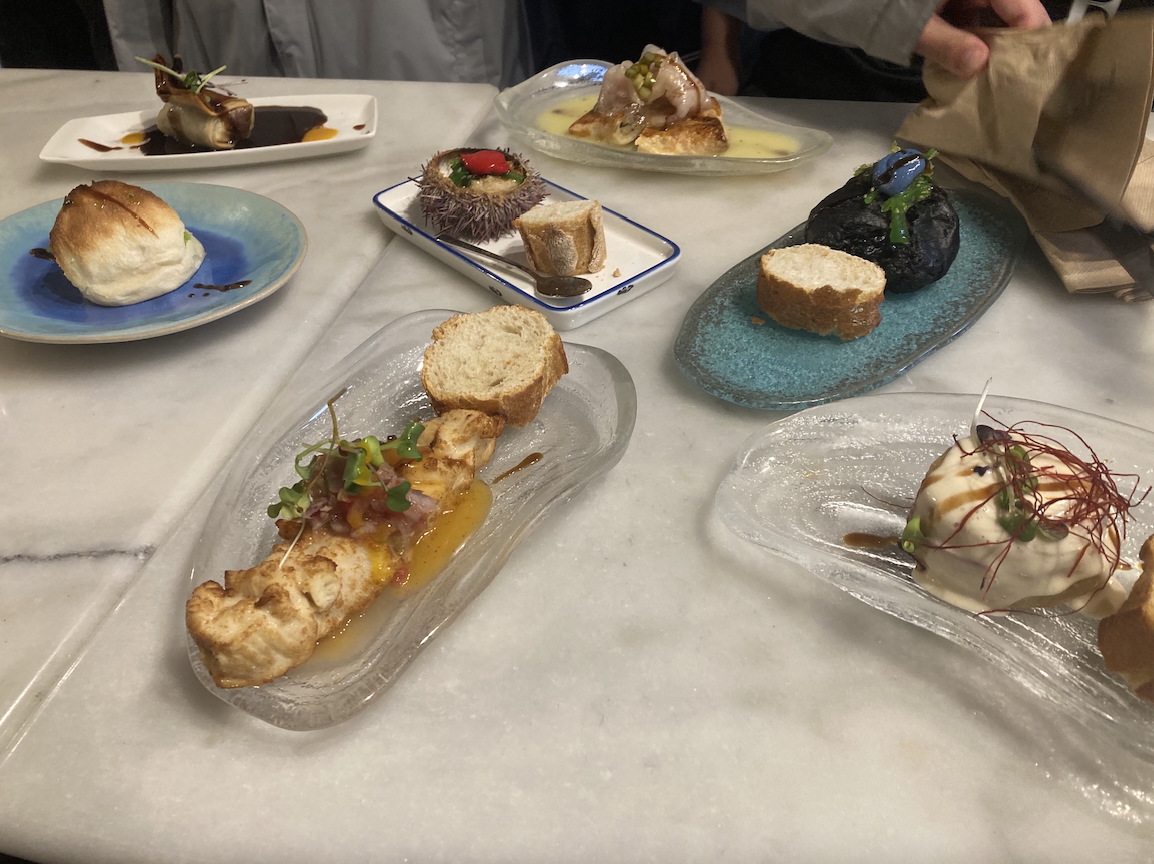
Next, we went to Bar Bergara, an award-winning restaurant. Here, we tried both hot and cold pintxos. Cold pintxos are the ones sitting in the glass displays at the front of the bar. They are already prepared and ready to be eaten. Hot pintxos, on the other hand, are made in the kitchen when you order them and often have more intricate preparation and presentation. Although different, both are delicious and show the bars’ unique creations.
One of the locations we passed by was the road along which the traditional bar-hopping way of eating pintxos was born, called Zabaleta Kalea, or Zabaleta Street, as Professor Zabalbeascoa explained. It has a group of restaurants whose owners tried to bring in business during Spain’s Great Recession by offering a drink and a pintxo for around two euros while limiting every person’s order to that one drink and pintxo. This encouraged customers to keep moving throughout the other restaurants to get their fill of pintxos. They would move down the rows of restaurants, bar-hopping from place to place, which caught on and become the traditional Basque way of eating pintxos.
We tried several other pinxto locations, such as a tortilla place, a place with jamón ibérico and octopus, and we finished off the tour with gelato. These dishes were delicious as well, and they also exist outside of the Basque country as Spanish cuisine in general.
I enjoy trying new things, especially food, and having the opportunity to eat such unique dishes that I would not have discovered on my own was incredible. I tried so many new flavors, and I absolutely loved them, even if I felt hesitant about eating some of them at first. The mentality behind trying pintxos can be applied in your day-to-day life as well: even if you are nervous or uncertain, it’s worth it to try something new. This tour encouraged me to continue studying Spanish and even some Basque, as understanding the language is a key aspect of understanding a culture and society, and it also allows you to engage with locals and their craft in a way that wouldn’t be possible otherwise. I started the study abroad shy and a little hesitant about being in an unfamiliar place, but the more we explore and immersive ourselves in the culture and the language, the more inspired I feel to keep learning and keep interacting with the unique culture and culinary traditions of not only this region, but the world.