Morning
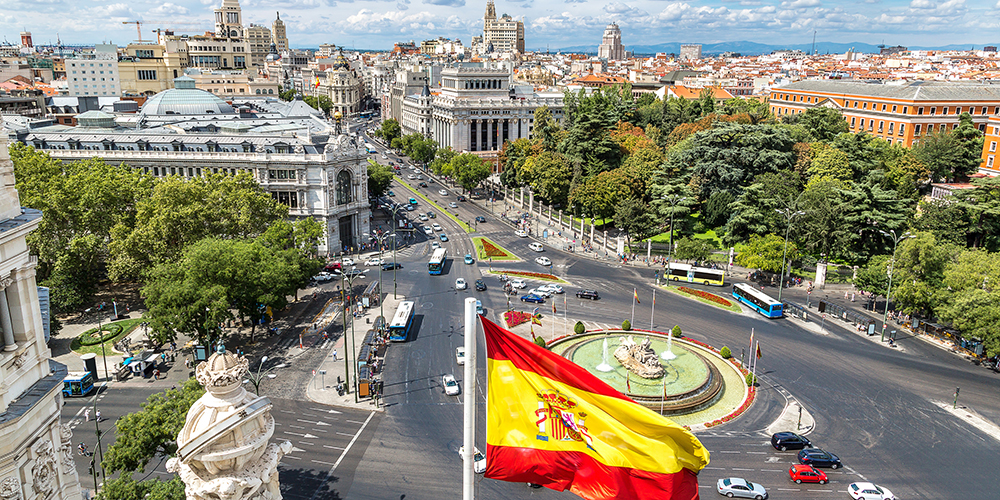
On the morning of March 9th at 10 am, our API Resident Director Fran and Julian led us on a walking tour of the city. The day prior, we had learned about the history of Spain beginning with the very first fortress here. Monday marked the beginning of our study of the Spanish Civil War, which began with a failed coup in the heart of Madrid. We walked through the center of Madrid and learned about the beginning of the Spanish Civil War and Madrid’s current culture through the landmarks around us.
After a big breakfast at Hotel Regina, we headed out to make our way through the city. When we reached Gran Via, we stopped outside of the Metro station to take in the buildings around us. We were right across the street from the Telefonica building from the Spanish Civil War era, which is now a Movistar flagship store and the Espacio Fundacion Telefonica. I thought it was so incredible to see the building that we had read about in Hotel Florida by Amanda Vaill. We had learned about Arturo Barea and Isla Kulscar, who were censors in this foreign press office during the Spanish Civil war. I had pictured the inside of it and the street view so clearly— the view out the windows through Barea’s eyes, where he and Ilsa would sleep through the sound of the shells, and the missing wall in the bedroom when one hit too close. The building had since been repaired after the shells, but Julian pointed out the black spots all over the wall facing the street. These were bullet holes dating back to the beginning of the Spanish Civil War, a permanent reminder of the Spanish Civil War.
Along the way, we stopped a few more times for Fran to give us lunch recommendations and orient us in the city. He had told us about the growing Asian population in Madrid, and how that has contributed to a growing population of amazing authentic Vietnamese, Chinese, and Japanese restaurants nearby. We stopped at the Monumento Cervantes in Plaza de Espana, a monument for the most famous Spanish writer of all time, known for Don Quixote. Julian gave us background on the bronze statues beneath him of Don Quixote and Sancho Panza, and we learned about the funny history of a Don Quixote film adaptation that was never completed. After taking some photos lining up our hands to be high-fiving Don, we headed to the Monumento a los Caidos en el Cuartel de la Montana, or the Monument of the Mountain Barracks.
The coup began at that exact location in 1936 on Principe Pio hill. We learned how these barracks were the location of the declaration of the war, how it was surrounded and attacked by Loyalists, and how it was eventually turned into a concentration camp for Republican soldiers by Franco in 1939. In 1972, the monument we stood at was erected in memory of those who had fallen while defending the barracks, the Nationalist soldiers.
We made our way up the stairs to the Temple of Debod, a beautiful structure that was a gift from Egypt in 1968 in gratitude of Spain’s support to preserve the Nubian temples. Behind this temple we went to the Príncipe Pío Mountain Viewpoint, which overlooked the Royal Palace. We got some incredible photos there, with the vast city and the woods in the background, which we had learned the day before were hunting grounds during medieval times.
Afternoon Free Time
After photos, Fran and Julian left us to explore the surrounding neighborhoods. We split into 3 groups to get food, which worked out well because there was such a great variety of restaurants around us. Chris, another student on the trip, and I hunted down a nearby tortilla at Pez Tortilla, while some of the others tried the local seafood at Anciano Rey de Los Vinos. We tried croquetas de jamon for the first time, a delicious, originally French, fried roll with a savory ham filling. We were recommended to get tortillas by Julian, and I had been anticipating something like a Mexican corn tortilla. I had not realized that tortilla was Spanish for omelet and was confused when the waitress brought out an egg dish with bread. Regardless, we devoured the tortilla and ordered another one later in the week because they made us believers.
Evening
At 7:30 pm we met at the Libreria Parenthesis, an English and Spanish bookstore near Embajadores station. That night, Julian was speaking about his book, What We Tried to Bury Grows Here, with American writer and co-founder of The Write Salon, Willow Mata. Julian discussed his writing process and inspirations for the book and then the floor was open to questions from the audience of students, fellow readers, and writers.
Reflection
I look back on this day as not only an adventure through Madrid, but an adventure through time. It was amazing to be able to physically see remains of history merely blocks away from modern culture. Madrid is shaped architecturally, culinary-wise, and socially through its complex history; its past is written on everything you pass. From bullet hole remains, bilingual bookstores, gifted temple from Egypt, Little Asia, French cuisine, to old hunting woods— Madrid is tattooed with its history and continues to grow in art, architecture, and cuisine to this day through each person that crosses its path.