Morning
After a good night of rest, still slightly adjusting to the jet lag, we embarked on our second day in Madrid. The second day in Madrid particularly stands out to me because it was our first full day in the city, packed with activities, tapas, and terrain still waiting to be uncovered. Our introduction to the day was meeting in the hotel lobby at 9:15 and departing to the Royal Collection Gallery, which is situated next to the Royal Palace and the Cathedral. Walking through the Royal Palace’s gardens, I could see the different generations of Madrid’s rich culture and history. There were statues of Madrid’s previous kings depicted with perfectly sculpted bodies in a variety of different poses, characterizing their personalities. The Royal Palace was stunning. It captured centuries of Madrid’s artwork, sculptures, and other items of historical significance. Most notably, the large tapestries hanging on the walls depicted scenes where colors seemed to pop out at you. My personal favorite was The Adoration of the Name of Jesus by El Greco, which portrays three different realms: heaven, earth, and hell. The painting had a wide array of beautiful colors and many different scenes depicting various relationships. Looking at the painting, it demonstrated the devotion Spaniards had to Christianity and the significance of the “final judgment” of an individual upon death.
Free Time
When the gallery visit ended, it was around 12:00 PM, and we ventured off into Europe’s largest open-air flea market, El Rastro. El Rastro had a completely different vibe compared to my traditional market expectations. It was chaotic, but more so an organized chaos filled with unpredictability. All of the stands were unique in their own way. Some had vintage clothing, old coins, modern toys, antiques, and more. Being in the market felt like a major cultural blend, with every generation mixing the past and present in one open space. I broke off from the main group and found a smaller, more niche store that focused on handmade goods and jewelry. Compared to the rest of the market, it was quieter and had a more local atmosphere. I was browsing through the jewelry hanging on a wooden wall when a handcrafted bead bracelet caught my eye. Unfortunately, I did not have any euros on me, only USD. Luckily, I used my persuasion skills and was able to convince the vendor to sell me two bracelets for ten USD. An intricate part of the flea market experience is bargaining. I utilized that to my advantage, and eventually the vendor gave up, nodded, and handed me the two bracelets—easy. After the market, a group of us went to a more touristy restaurant that had authentic Spanish dishes but also offered wings and burgers. I regret to inform you that I did choose the burger. While everyone else was eating authentic Spanish dishes, I was eating something I could have ordered at virtually any American restaurant. That small decision had a lasting impact on the rest of the trip. It taught me how easy it is to fall back into your comfort zone, and I promised myself that for the remainder of the trip, I would fully experience Spanish cuisine. Later that night, I redeemed myself. We went out for tapas in smaller groups, and my group chose more locally established tapas bars. We shared a variety of different dishes, chorizo, charcuterie featuring locally made cheese and crackers, and toast with the famous Iberian ham and olive oil. To finish off the night, we connected with a larger group and had churros con chocolate.
Reflection
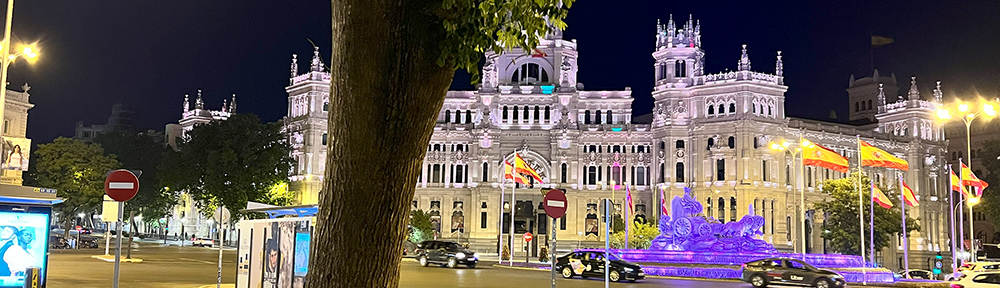
Looking back on the entire day, it draws clear connections to the broader themes of Madrid’s past and present. The Royal Collection Gallery showed me the sheer depth of Spain’s history, going back many centuries. This is a unique concept to me because the United States dates back to 1776, whereas Spain’s history extends as far back as it can be documented. My experience in the museum only confirmed the historic tradition, religion, and power that I learned about during the pre-departure lectures. The flea market, on the other hand, represents a more modern aspect of Spain while still incorporating its past. Going into Madrid, I expected to see a clash between the duality of Spain’s past and present. While there certainly are moments of contrast, I noticed that the past and present more so complement each other. For example, while simply strolling down the streets of Madrid, you can see historic buildings that date back centuries with influences from Romanesque times, and then, right next to them, something like a McDonald’s. Taking a step back, nothing seems out of place. Everything exists exactly where it is supposed to be. If I could describe Madrid in three words, I would say: historic, contrasting, and alive. Alive because, within just a week, it has created memories that I will carry with me for the rest of my life.