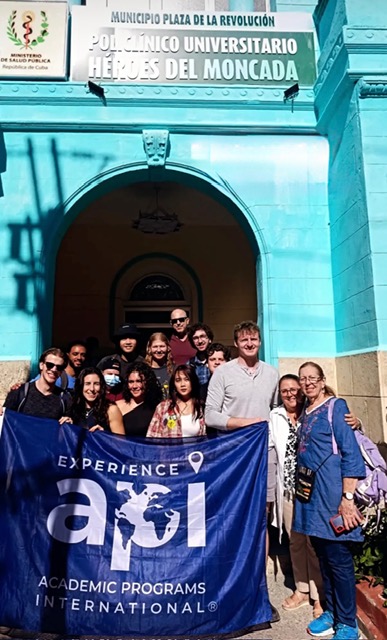
When I was walking into a Cuban polyclinic on Thursday, I didn’t think I was about to have a perspective changing nursing moment. I thought I was just going to tour a healthcare facility, take some notes, take a few pictures, and move on. Instead, I walked out quietly rethinking what healthcare looks like, what nursing really means, and how different it feels when care is centered on people instead of paperwork.
As a sophomore nursing student in the U.S., I’m used to learning healthcare through textbooks, PowerPoints, and simulation labs where the mannequin never complains. Being inside a functioning polyclinic felt different immediately. This wasn’t a huge hospital or a shiny medical center either. It blended right into the neighborhood looking just like another colorful building. The building’s parts were reused from old homes, which made it feel less intimidating and more personal. Healthcare here didn’t feel distant. It felt accessible in the middle of each neighborhood.
One of the first things that stood out to me was the role of nurses. In the Cuban polyclinic healthcare system, each family doctor works directly with a family nurse, and together they care for a specific group of people in the community. Everyone is known. Everyone is followed. From a nursing student perspective, that continuity honestly felt powerful.
In the U.S., nurses do a little bit of everything. Somehow they still don’t get enough credit. Hearing about nurses in Cuba being so deeply involved in long-term patient relationships reminded me why I chose this profession in the first place. Nursing here wasn’t just task-based. It was connection and relationship based. Nurses weren’t rushing room to room. They were focused on being educators and consistent faces in their patients’ daily lives. That’s the kind of nurse I want to be.
Another huge difference was how prevention is prioritized. Patients are grouped based on their health status, ranging from focusing on healthy individuals to those with chronic illness or disabilities. This system allows healthcare providers to care for whatever occurs early instead of going into the hospital when symptoms are visible and get worse. As someone who has spent countless hours memorizing disease processes, this approach felt refreshing. Instead of asking, “What do we do when someone is sick?” the Cuban healthcare system asks, “How do we keep them healthy?”. That mindset shift stuck with me.
One of the most impactful things I learned about was home visits. Nurses regularly visit patients in their homes, especially elderly individuals or those with chronic conditions. In the U.S., we talk a lot about social determinants of health, but knowing providers enter patients’ living environments makes those concepts impossible to ignore. You can’t get a look into someone’s housing, family support, or daily challenges when you’re sitting on someone’s couch. It made holistic care feel real. It didn’t feel like just something we write about in care plans.
The polyclinic also functions as a teaching site for healthcare students. Nursing and medical students begin hands-on learning early, observing real patient care and even emergency situations. As a nursing student who loves to learn in labs and hands-on experiences, this honestly made me a little jealous. It reinforced that confidence in healthcare doesn’t automatically appear after graduation. It’s built over time, through experience, mentorship, and actually being present with patients.
One story shared during our visit really stuck with me. A physician described experiencing sudden chest pain and how quickly the emergency system responded. Care was immediate. The healthcare team provided help with no hesitation, no insurance questions, and no fear of cost. As someone studying healthcare in the U.S., this hit hard. So many people delay care here because they’re scared of the bill more than the symptoms. In Cuba, the focus was simply on treating the patient. That contrast made me reflect on how deeply financial stress is woven into American healthcare and how much that affects outcomes.
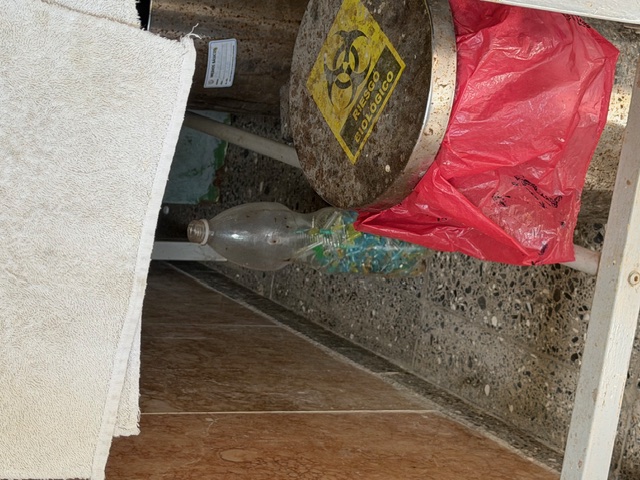
The polyclinic isn’t perfect though. There are shortages of medications and advanced technology, and providers are very aware of those limitations. But instead of stopping care, they adapt and learn new effective methods. Prevention, rehabilitation, research, and even traditional medicine play major roles. This changed my assumption that quality healthcare always requires high-tech equipment. Instead I saw that organization, consistency, and commitment can go a long way. Even with fewer resources the patients can be cared for as long as there’s passion.
Leaving the polyclinic, I felt changed in a quiet but meaningful way. This experience didn’t make me think one healthcare system is perfect and another is failing. What it did was give me a different perspective. It reminded me that nursing is more than skills, checklists, and charting (even though those things consume nursing student’s lives). Nursing is about relationships. It’s about showing up. It’s about caring for people within the context of their lives. That’s exactly what Cuba showed.
This visit reminded me of why I chose nursing. Not because it’s easy or glamorous, but because nursing has the power to connect healthcare to the community. The Cuban polyclinic showed me that meaningful care doesn’t always begin in a hospital. Sometimes, it begins by knowing your patients, understanding their lives, and choosing compassion every single day.